Professional skills
Deep Learning Specialization
Eight-day, 60-hour deep learning course where you build and train neural networks, CNNs, RNNs and transformers in TensorFlow and PyTorch.
THE BIG PICTURE
About this course
The Deep Learning Specialization is a multi-course certificate of completion awarded by DeepLearning.AI and delivered on Coursera. It recognises learners who finish the sequence of courses and graded assessments covering core deep learning topics. Across eight days you will design, train and evaluate models for vision and NLP, working with TensorFlow and PyTorch. You will implement feedforward nets, CNNs, RNNs, LSTMs and introductory transformer workflows, apply regularisation and optimisation techniques, and complete structured labs that mirror the specialization’s assignments. There is no single proctored exam for this credential. Instead, you earn the certificate by completing the specialization’s graded quizzes and programming assignments on Coursera. This course includes a mock assessment and guidance to plan, enrol, and submit the required online assessments. DeepLearning.AI owns the certification scheme. MindClick provides training and exam preparation and is not an accredited or authorised partner.
What you’ll learn
- Build feedforward neural networks with appropriate activations, loss functions and initialisation
- Train deep models using mini-batch SGD, adaptive optimisers, learning-rate schedules and regularisation (L2, dropout, batch norm)
- Diagnose bias/variance, design robust train/dev/test splits and run systematic error analysis
- Implement and fine-tune CNNs for image classification, transfer learning and data augmentation
- Develop sequence models (RNNs, LSTMs, GRUs) with embeddings, attention and introductory transformer-based NLP pipelines
- Use TensorFlow and PyTorch effectively, including data pipelines, training loops, callbacks and experiment tracking
- Prepare models for production considerations such as reproducibility, evaluation, and basic deployment options
- Prepare for the specialization’s graded quizzes and programming assignments with practice tasks and a mock assessment
A CLEAR PATH FORWARD
8-day Deep Learning Specialization agenda
8 instructor-led days (60 contact hours) mapped to the exam domains. Each day combines short concept sessions, hands-on practice on a running case study and exam-style questions.
- Learning route
- 8 recommended days
- Practical work
- 8 guided activities
- Finish with
- Mock exam + certification exam
Take a look at each day. Open a section to see the topics and practical work.
Day 1Foundations of neural networksNeural networks fundamentals; optimisation basics
What we’ll cover
- 09:00–09:30 · Course kickoff, goals, environment check and repo access
- 09:30–10:30 · Python/NumPy review and vectorisation for deep learning
- 10:45–12:15 · Logistic regression as a neural net: loss, gradients and SGD
- 13:15–14:45 · Activation functions, weight initialisation and normalisation
- 15:00–16:15 · Forward/backprop from scratch; automatic differentiation concepts
- 16:15–17:00 · TensorFlow and PyTorch primers: tensors, modules and training loops
- 17:00–17:30 · Exam-style practice questions and wrap-up
Put it into practice
Build a two-layer neural network from scratch in NumPy, then re-implement it in TensorFlow and PyTorch. Compare training curves and accuracy across implementations.
You’ll take away
Working notebooks for scratch, TensorFlow and PyTorch MLPs with notes on differences
Day 2Optimisation and regularisationOptimisation; regularisation; hyperparameter tuning
What we’ll cover
- 09:00–09:30 · Recap of Day 1 and Q&A
- 09:30–10:30 · Mini-batch SGD, momentum, RMSProp and Adam
- 10:45–12:15 · Learning-rate schedules, early stopping and gradient clipping
- 13:15–14:45 · Regularisation: L2, dropout and batch normalisation in practice
- 15:00–16:15 · Systematic hyperparameter tuning and experiment tracking
- 16:15–17:00 · Exam-style practice questions using optimisation and tuning scenarios
- 17:00–17:30 · Lab debrief and key takeaways
Put it into practice
Tune an MLP on a tabular dataset using different optimisers, L2, dropout and batch norm. Track experiments and select a configuration based on validation metrics.
You’ll take away
Hyperparameter tuning report with chosen configuration and learning-curve plots
Day 3ML project strategy and error analysisProject strategy; data management; error analysis
What we’ll cover
- 09:00–09:30 · Recap of Day 2 and Q&A
- 09:30–10:30 · Data splits, leakage avoidance and metric selection
- 10:45–12:15 · Bias/variance diagnosis and prioritising improvements
- 13:15–14:45 · Error analysis, ablation studies and robust evaluation
- 15:00–16:15 · Data augmentation, class imbalance and transfer learning decisions
- 16:15–17:00 · Exam-style practice questions on strategy and diagnosis
- 17:00–17:30 · Lab debrief and action plan
Put it into practice
Perform structured error analysis on a pre-trained model, propose targeted fixes, and validate the impact via controlled experiments.
You’ll take away
Error analysis worksheet and experiment log with recommendations
Day 4Convolutional neural networksCNNs; computer vision; transfer learning
What we’ll cover
- 09:00–09:30 · Recap of Day 3 and Q&A
- 09:30–10:30 · Convolutions, pooling and receptive fields
- 10:45–12:15 · Modern CNN architectures (VGG, ResNet) and design choices
- 13:15–14:45 · Data pipelines and augmentation for images
- 15:00–16:15 · Transfer learning and fine-tuning a pretrained CNN
- 16:15–17:00 · Exam-style practice questions on CNN concepts and troubleshooting
- 17:00–17:30 · Lab debrief and checkpoint
Put it into practice
Fine-tune a ResNet on a custom image dataset, comparing feature extractor vs full fine-tuning. Evaluate accuracy and confusion matrices.
You’ll take away
Fine-tuned CNN model checkpoint and evaluation notebook
Day 5Sequence models: RNNs and LSTMsSequence models; embeddings; attention (intro)
What we’ll cover
- 09:00–09:30 · Recap of Day 4 and Q&A
- 09:30–10:30 · RNNs, LSTMs, GRUs and vanishing/exploding gradients
- 10:45–12:15 · Word embeddings and sequence batching/padding
- 13:15–14:45 · Sequence-to-sequence modelling and teacher forcing
- 15:00–16:15 · Attention mechanisms and alignment basics
- 16:15–17:00 · Exam-style practice questions on sequence modelling
- 17:00–17:30 · Lab debrief and reading list
Put it into practice
Train an LSTM-based text classifier with pretrained embeddings and compare against a GRU baseline. Add a simple attention layer and assess impact.
You’ll take away
Sequence model notebooks with results table and commentary
Day 6Transformers and modern NLPTransformers; tokenisation; fine-tuning
What we’ll cover
- 09:00–09:30 · Recap of Day 5 and Q&A
- 09:30–10:30 · Self-attention, encoder–decoder and positional encodings
- 10:45–12:15 · Subword tokenisation and batching for transformers
- 13:15–14:45 · Fine-tuning a pretrained transformer for text classification
- 15:00–16:15 · Evaluation, error analysis and prompt-based baselines
- 16:15–17:00 · Exam-style practice questions on transformers and NLP
- 17:00–17:30 · Lab debrief and next steps
Put it into practice
Fine-tune a small transformer model on an NLP task, measuring accuracy and calibration. Compare with an LSTM baseline on the same data.
You’ll take away
Transformer fine-tuning notebook and comparison report
Day 7Practical workflows and deployment basicsPractical model development; project strategy
What we’ll cover
- 09:00–09:30 · Recap of Day 6 and Q&A
- 09:30–10:30 · Efficient data input pipelines and mixed-precision training
- 10:45–12:15 · Reproducibility, experiment tracking and model versioning
- 13:15–14:45 · Exporting models (SavedModel, TorchScript, ONNX) and inference
- 15:00–16:15 · Serving options, performance measurement and monitoring basics
- 16:15–17:00 · Exam-style practice questions integrating end-to-end workflows
- 17:00–17:30 · Lab debrief and readiness check
Put it into practice
Package a trained model for inference and serve it locally via a simple API, profiling latency and throughput.
You’ll take away
Exported model artefacts and a minimal serving endpoint
Day 8Capstone labs, mock assessment and next stepsIntegration across all domains; assessment readiness
What we’ll cover
- 09:00–09:30 · Recap of Day 7 and plan for capstone
- 09:30–10:30 · Capstone scoping: choose CV or NLP pathway and dataset
- 10:45–12:15 · Build: data pipeline, baseline model and metrics
- 13:15–14:45 · Improve: tuning, regularisation and error analysis
- 15:00–16:15 · Mock assessment mirroring graded quiz and coding tasks
- 16:15–17:00 · Capstone presentations and feedback
- 17:00–17:30 · Specialization enrolment and submission guidance (booking and timelines)
Put it into practice
Complete a mini end-to-end project in the chosen pathway and sit a timed mock assessment aligned to typical graded tasks. Receive targeted feedback and a personal completion plan.
You’ll take away
Capstone notebook, mock assessment score report and Coursera submission plan
Bring it all together
Certification exam: DeepLearning.AI Deep Learning Specialization (Coursera), awarded by DeepLearning.AI. Confirm the current exam format with the awarding body when you book. Every attendee also receives a MindClick certificate of completion for 60 contact hours.
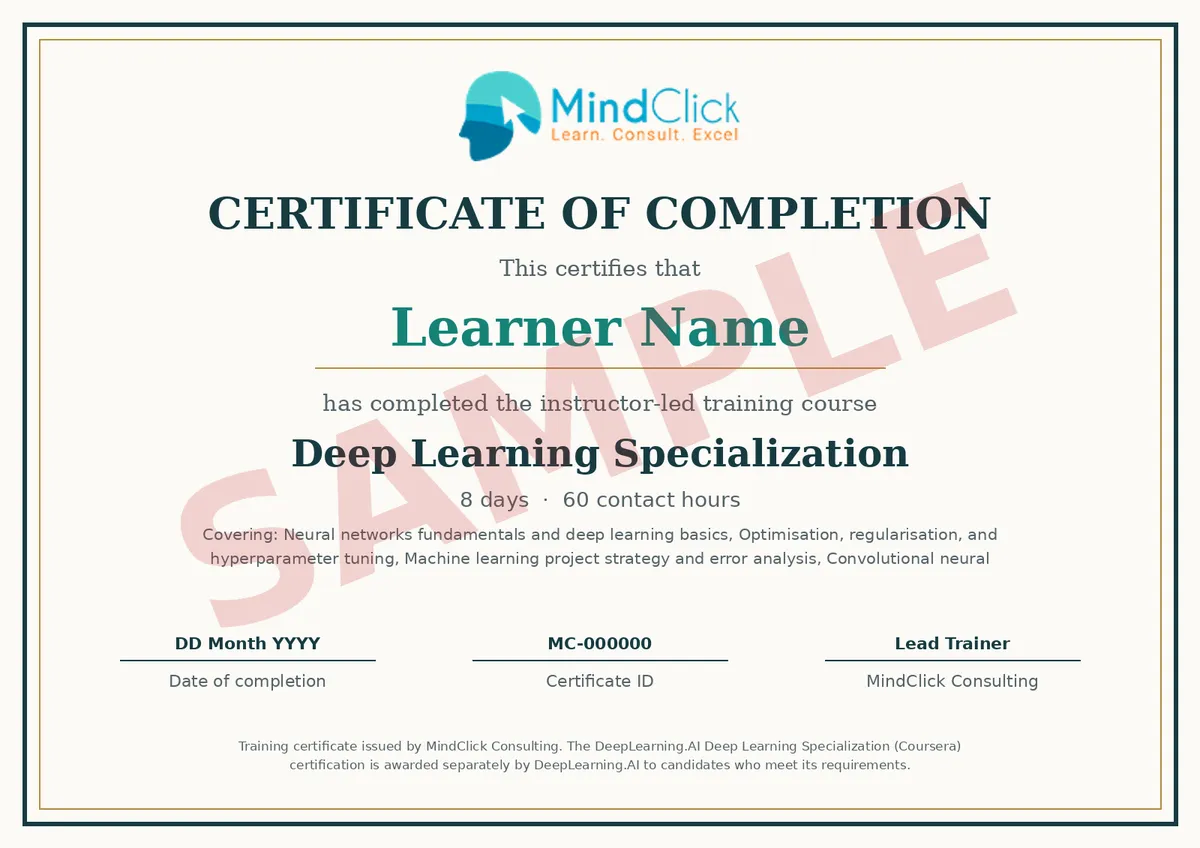
What you receive
You earn two separate credentials. The sample shows the MindClick training certificate.
- MindClick certificate of completion: 8 days, 60 contact hours, issued to every attendee who completes the course.
- DeepLearning.AI Deep Learning Specialization (Coursera): issued by DeepLearning.AI when you meet its requirements and pass the exam.
Before you choose your learning route
Certification route: This credential is earned by completing the Coursera specialization’s graded quizzes and programming assignments, not by a single voucher-based exam.
Session timings are indicative; the trainer may adjust them for the group. Exam details reflect the awarding body’s published information at the time of writing; confirm the current version when you book.
DeepLearning.AI owns this certification scheme. MindClick provides training and exam preparation and is not an accredited or authorised partner of DeepLearning.AI.
Fees
| Delivery format | Fee per learner | Exam fee |
|---|---|---|
| Live online | $2,800 USD | Included |
| Classroom | $4,500 USD | Included |
One awarding-body certification exam attempt is included in the training fee. Confirm the current fee, any applicable tax and what the fee covers in writing before you pay.
Prerequisites
- Recommended: solid Python programming, basic linear algebra (vectors, matrices), probability and calculus; prior machine learning exposure is helpful. Bring a laptop with admin rights, a modern browser, and ability to run Python, TensorFlow and PyTorch (install guidance provided).
FIND YOUR START
Confirmed batch starts
Choose a published start, then review your offer in the same enrollment flow. A start date is not the full timetable or a seat reservation.
Choose your country & monthStarts
- Training location
- Manama, Bahrain
- Local timezone
- Asia/Bahrain
Venue and full session timetable to be supplied.
Starts
- Training location
- Cairo, Egypt
- Local timezone
- Africa/Cairo
Venue and full session timetable to be supplied.
Starts
- Training location
- Kuwait City, Kuwait
- Local timezone
- Asia/Kuwait
Venue and full session timetable to be supplied.
Starts
- Training location
- Muscat, Oman
- Local timezone
- Asia/Muscat
Venue and full session timetable to be supplied.
Starts
- Training location
- Doha, Qatar
- Local timezone
- Asia/Qatar
Venue and full session timetable to be supplied.
Starts
- Training location
- Riyadh, Saudi Arabia
- Local timezone
- Asia/Riyadh
Venue and full session timetable to be supplied.
Frequently asked questions
How long is the course?
8 days, 60 contact hours, normally 09:00 to 17:30 with breaks. The agenda follows the exam domains and the final day includes a mock exam.
Is the exam included?
Yes. Outside India the fee includes one certification exam attempt. Retakes are booked and paid directly with the awarding body. This credential is earned by completing the Coursera specialization’s graded quizzes and programming assignments, not by a single voucher-based exam.
Are there prerequisites?
Recommended: solid Python programming, basic linear algebra (vectors, matrices), probability and calculus; prior machine learning exposure is helpful. Bring a laptop with admin rights, a modern browser, and ability to run Python, TensorFlow and PyTorch (install guidance provided).
What certificate will I receive?
Two credentials. MindClick issues a certificate of completion for 60 contact hours to every attendee. DeepLearning.AI issues the DeepLearning.AI Deep Learning Specialization (Coursera) certification when you pass the exam and meet its requirements.
Is MindClick an accredited training partner for this certification?
MindClick provides training and preparation and is not an accredited/authorised partner of DeepLearning.AI. The specialization is delivered and assessed on Coursera, with certificates issued on completion of the online courses.
KEEP EXPLORING
More ways to move forward.
Related training from the course catalog.

Data Science and Machine Learning Bootcamp
Ten-day, 80-hour bootcamp to build Python, statistics and machine learning skills through projects on real data with daily exam-style drills.
Machine Learning A-Z
Six-day (44-hour) course where you build and evaluate machine learning models in Python and R, practise labs daily, and prepare for certification.
Python for Data Analysis
Three-day Python for Data Analysis course where you clean, transform, visualise, and explore datasets using pandas, NumPy, and matplotlib with practical labs.

Microsoft Power BI Data Analysis
Build practical skills in data preparation with power query and data models and dax calculations.