Professional skills
Machine Learning A-Z
Six-day (44-hour) course where you build and evaluate machine learning models in Python and R, practise labs daily, and prepare for certification.
THE BIG PICTURE
About this course
This course prepares you for a machine learning professional certification that recognises the ability to frame ML problems, build reliable models, and operate them responsibly. Such credentials are awarded by industry bodies and cloud providers; you should select the provider and credential that matches your role and platform. Across six days, you will work through supervised and unsupervised learning, model evaluation, feature engineering, tuning, and deployment. You will implement algorithms in Python (with optional R equivalents), complete hands-on labs, and apply techniques to realistic datasets, with daily exam-style practice. Exam format, duration, and policies vary by awarding body. The course includes a timed mock exam and guidance on mapping objectives to your chosen certification and booking with the provider’s portal. The awarding body owns the certification scheme. MindClick provides training and exam preparation and is not an accredited or authorised partner.
What you’ll learn
- Frame machine learning problems, define success metrics, and assess feasibility
- Prepare, cleanse, and engineer features from structured and unstructured data
- Build and evaluate supervised models for regression and classification
- Apply unsupervised methods for clustering and dimensionality reduction
- Tune models with cross-validation, manage bias–variance trade-offs, and interpret results
- Package, deploy, and monitor models with basic MLOps practices and governance controls
- Address responsible AI concerns, including fairness, bias, and explainability
- Practise exam-style questions, sit a mock exam, and create a targeted revision plan
A CLEAR PATH FORWARD
6-day Machine Learning A-Z agenda
6 instructor-led days (44 contact hours) mapped to the exam domains. Each day combines short concept sessions, hands-on practice on a running case study and exam-style questions.
- Learning route
- 6 recommended days
- Practical work
- 6 guided activities
- Finish with
- Mock exam + certification exam
Take a look at each day. Open a section to see the topics and practical work.
Day 1Problem framing, data understanding, and preparationProblem framing; data collection and preparation; feature engineering
What we’ll cover
- 09:00–09:30 · Course induction, objectives, and success criteria
- 09:30–10:30 · Problem framing, target definition, and leakage avoidance
- 10:45–12:30 · Data sources, sampling, quality checks, and exploratory analysis
- 13:15–14:30 · Data wrangling in Python (pandas); R tidyverse parallels
- 14:30–15:15 · Feature definition and handling missing, categorical, and skewed data
- 15:15–16:15 · Exam-style practice questions: problem framing and data prep
- 16:15–16:30 · Day wrap-up and take-home reading
Put it into practice
Profile a real-world tabular dataset, articulate the business question, define evaluation metrics, and produce a data quality report. Implement a reproducible data cleaning pipeline in Python (with optional R script).
You’ll take away
Problem statement and data audit with a reproducible cleaning notebook
Day 2Supervised learning basics and evaluationSupervised learning; metrics; validation
What we’ll cover
- 09:00–09:30 · Recap and Q&A
- 09:30–10:30 · Linear and logistic regression: assumptions and baselines
- 10:45–12:30 · Train/validation/test splits, cross-validation, and metrics (RMSE, AUC, F1)
- 13:15–14:00 · Regularisation (Ridge/Lasso) and feature scaling
- 14:00–15:00 · Naïve Bayes, k-NN, and support vector machines overview
- 15:00–16:00 · Error analysis and bias–variance trade-offs with learning curves
- 16:00–16:30 · Exam-style practice questions: metrics and model selection
Put it into practice
Build baseline regression and classification models with proper validation, comparing metrics and learning curves. Document model assumptions and next steps based on error analysis.
You’ll take away
Baseline model notebooks with evaluation reports and learning curves
Day 3Trees, ensembles, and feature engineeringSupervised learning; feature engineering; tuning and validation
What we’ll cover
- 09:00–09:30 · Recap and Q&A
- 09:30–10:30 · Decision trees and impurity measures
- 10:45–12:30 · Ensembles: random forests and gradient boosting (XGBoost/LightGBM concepts)
- 13:15–14:00 · Feature engineering for tabular data and pipelines
- 14:00–15:00 · Hyperparameter tuning with grid/random search and early stopping
- 15:00–16:00 · Model interpretability: permutation importance and partial dependence
- 16:00–16:30 · Exam-style practice questions: ensembles and tuning
Put it into practice
Engineer features, train tree-based and boosting models, and run a structured tuning experiment. Compare performance and interpretability to select a recommended model.
You’ll take away
Feature-engineered dataset and tuned ensemble model with interpretation
Day 4Unsupervised learning, dimensionality reduction, and anomaly detectionUnsupervised learning; dimensionality reduction; evaluation
What we’ll cover
- 09:00–09:30 · Recap and Q&A
- 09:30–10:30 · Clustering methods: k-means and hierarchical clustering
- 10:45–12:30 · Dimensionality reduction: PCA and t-SNE/UMAP concepts
- 13:15–14:00 · Similarity measures and feature scaling for unsupervised tasks
- 14:00–15:00 · Anomaly detection approaches and practical thresholds
- 15:00–16:00 · Evaluating unsupervised results and visualising clusters
- 16:00–16:30 · Exam-style practice questions: clustering and reduction
Put it into practice
Apply clustering and PCA to a multi-feature dataset to discover segments, then validate findings with internal metrics and visualisations. Propose actions for two segments based on insights.
You’ll take away
Cluster analysis report and dimensionality reduction notebook
Day 5Deployment, MLOps, monitoring, and responsible AIDeployment and MLOps; monitoring; governance and responsible AI
What we’ll cover
- 09:00–09:30 · Recap and Q&A
- 09:30–10:30 · Packaging models with pipelines and reproducible environments
- 10:45–12:30 · Serving basics: REST endpoints, batch vs real-time scoring
- 13:15–14:00 · Monitoring performance, drift detection, and retraining triggers
- 14:00–15:00 · Data and model governance: versioning, lineage, and documentation
- 15:00–16:00 · Responsible AI: fairness checks, bias mitigation, and explainability (SHAP/LIME)
- 16:00–16:30 · Exam-style practice questions: deployment, monitoring, and ethics
Put it into practice
Containerise a trained model and expose a local REST endpoint for scoring with logging. Implement a simple drift check and document governance controls and risk mitigations.
You’ll take away
Packaged model service, monitoring checklist, and governance notes
Day 6Neural networks, revision, mock exam, and next stepsSupervised learning; evaluation; exam preparation and booking
What we’ll cover
- 09:00–09:30 · Recap and Q&A
- 09:30–10:30 · Neural network basics: architectures, activation, and optimisation
- 10:45–12:30 · Build and evaluate a simple deep learning model for classification
- 13:15–14:00 · Consolidated review: objectives, pitfalls, and strategy
- 14:00–14:30 · Exam techniques: timing, elimination, and question patterns
- 14:30–16:00 · Timed mock exam and group debrief
- 16:00–16:30 · Exam booking guidance and personal revision plan
Put it into practice
Implement a small feed-forward network on a tabular or image dataset, comparing its performance with classical models. Sit a timed mock exam and refine your personal study plan using the debrief.
You’ll take away
Neural network lab, mock exam score report, and exam booking checklist
Bring it all together
Certification exam: Machine Learning A-Z. Confirm the current exam format with the awarding body when you book. Every attendee also receives a MindClick certificate of completion for 44 contact hours.
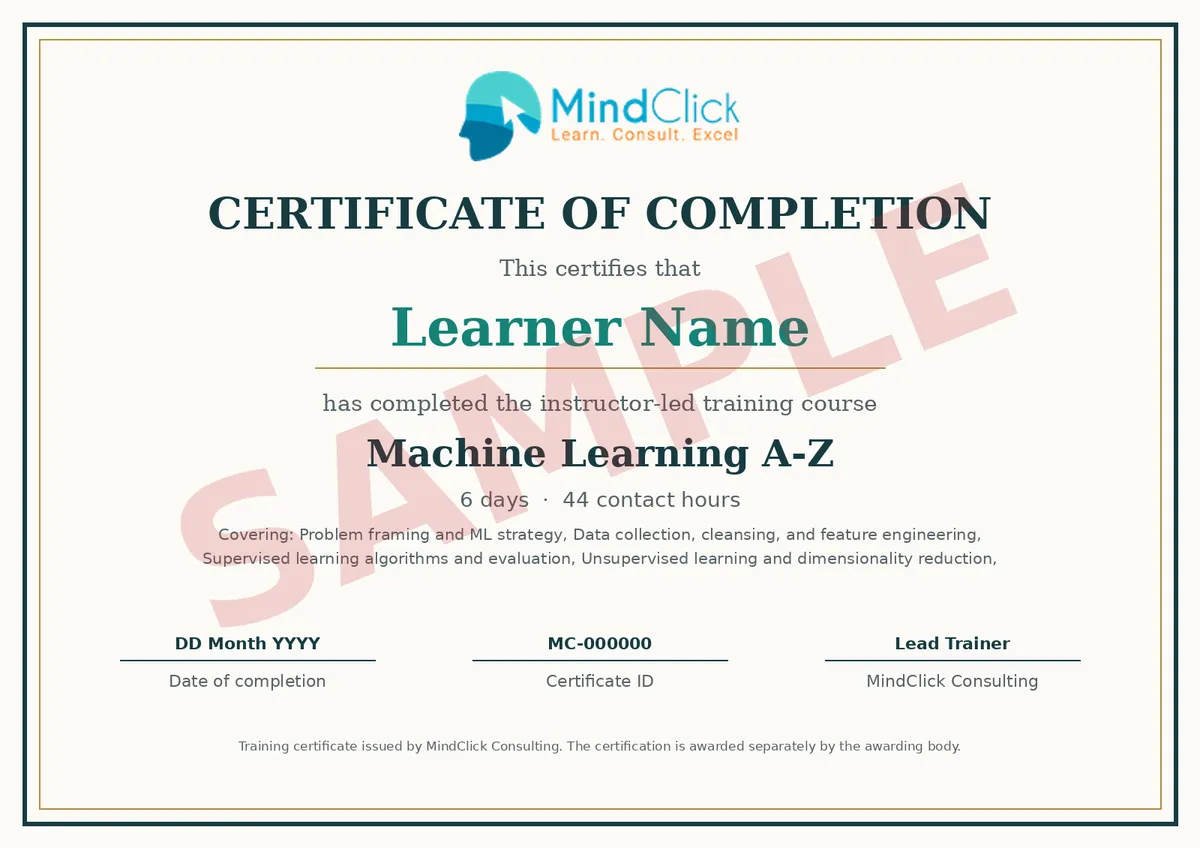
What you receive
You earn two separate credentials. The sample shows the MindClick training certificate.
- MindClick certificate of completion: 6 days, 44 contact hours, issued to every attendee who completes the course.
- Machine Learning A-Z: issued by the awarding body when you meet its requirements and pass the exam.
Before you choose your learning route
Session timings are indicative; the trainer may adjust them for the group. Exam details reflect the awarding body’s published information at the time of writing; confirm the current version when you book.
The awarding body owns this certification scheme. MindClick provides training and exam preparation and is not an accredited or authorised partner of the awarding body.
Fees
| Delivery format | Fee per learner | Exam fee |
|---|---|---|
| Live online | $2,800 USD | Included |
| Classroom | $4,500 USD | Included |
One awarding-body certification exam attempt is included in the training fee. Confirm the current fee, any applicable tax and what the fee covers in writing before you pay.
Prerequisites
- Recommended: basic Python programming, core statistics (distributions, hypothesis tests), linear algebra concepts, and familiarity with Jupyter or RStudio. Bring a laptop with admin rights, Python 3.11 (or Anaconda), a modern browser, Git installed, and optionally R (≥4.3) with RStudio.
FIND YOUR START
Confirmed batch starts
Choose a published start, then review your offer in the same enrollment flow. A start date is not the full timetable or a seat reservation.
Choose your country & monthStarts
- Training location
- Manama, Bahrain
- Local timezone
- Asia/Bahrain
Joining details and full session timetable to be supplied.
Starts
- Training location
- Cairo, Egypt
- Local timezone
- Africa/Cairo
Joining details and full session timetable to be supplied.
Starts
- Training location
- Kuwait City, Kuwait
- Local timezone
- Asia/Kuwait
Joining details and full session timetable to be supplied.
Starts
- Training location
- Muscat, Oman
- Local timezone
- Asia/Muscat
Joining details and full session timetable to be supplied.
Starts
- Training location
- Doha, Qatar
- Local timezone
- Asia/Qatar
Joining details and full session timetable to be supplied.
Starts
- Training location
- Riyadh, Saudi Arabia
- Local timezone
- Asia/Riyadh
Joining details and full session timetable to be supplied.
Frequently asked questions
How long is the course?
6 days, 44 contact hours, normally 09:00 to 16:30 with breaks. The agenda follows the exam domains and the final day includes a mock exam.
Is the exam included?
Yes. Outside India the fee includes one certification exam attempt. Retakes are booked and paid directly with the awarding body.
Are there prerequisites?
Recommended: basic Python programming, core statistics (distributions, hypothesis tests), linear algebra concepts, and familiarity with Jupyter or RStudio. Bring a laptop with admin rights, Python 3.11 (or Anaconda), a modern browser, Git installed, and optionally R (≥4.3) with RStudio.
What certificate will I receive?
Two credentials. MindClick issues a certificate of completion for 44 contact hours to every attendee. The awarding body issues the Machine Learning A-Z certification when you pass the exam and meet its requirements.
Is MindClick an accredited training partner for this certification?
MindClick provides training and exam preparation and is not an accredited/authorised partner of any awarding body; certification exams are administered directly by the relevant provider or its exam delivery partners.
KEEP EXPLORING
More ways to move forward.
Related training from the course catalog.

Data Science and Machine Learning Bootcamp
Ten-day, 80-hour bootcamp to build Python, statistics and machine learning skills through projects on real data with daily exam-style drills.
Python for Data Analysis
Three-day Python for Data Analysis course where you clean, transform, visualise, and explore datasets using pandas, NumPy, and matplotlib with practical labs.
Deep Learning Specialization
Eight-day, 60-hour deep learning course where you build and train neural networks, CNNs, RNNs and transformers in TensorFlow and PyTorch.

Microsoft Power BI Data Analysis
Build practical skills in data preparation with power query and data models and dax calculations.