Certification preparation
Certified Ethical Hacker (CEH) in Frankfurt
Showing starts assigned to Frankfurt. Change country or city · Global course
Five-day course to practise ethical hacking: reconnaissance, scanning, exploitation, web and wireless attacks, with hands-on labs and exam prep.
THE BIG PICTURE
About this course
Certified Ethical Hacker (CEH) is a cyber security certification awarded by EC-Council that validates knowledge of offensive security tools, techniques, and countermeasures used by ethical hackers. Across five days (09:00 to 17:30), you will work through the ethical hacking lifecycle with guided labs: reconnaissance, scanning and enumeration, gaining access, post-exploitation, web and SQL injection, wireless and cloud attack paths, and cryptography. Each day includes practical exercises, exam-style questions, and structured debriefs. The CEH exam is a knowledge-based test with 125 multiple-choice questions over 240 minutes, closed book. Passing scores vary by exam form. It is delivered at Pearson VUE test centres or via EC-Council remote proctoring, and the credential is typically valid for three years with renewal through EC-Council Continuing Education (ECE). EC-Council owns the certification scheme. MindClick provides training and exam preparation and is not an accredited or authorised partner.
What you’ll learn
- Plan and execute reconnaissance using OSINT methods and network scanning tools
- Enumerate network services and accounts and prioritise vulnerabilities for exploitation
- Gain and maintain access safely in a lab, including privilege escalation and lateral movement
- Analyse malware behaviours and captured traffic to identify indicators and mitigations
- Evaluate and exploit common web application flaws including XSS and SQL injection
- Assess wireless, mobile, IoT/OT, and basic cloud attack paths and explain countermeasures
- Document findings with clear evidence, risk, and remediation advice suitable for stakeholders
- Practise exam-style questions and a timed mock to prepare effectively for the CEH exam
A CLEAR PATH FORWARD
5-day Certified Ethical Hacker (CEH) agenda
5 instructor-led days (40 contact hours) mapped to the exam domains. Each day combines short concept sessions, hands-on practice on a running case study and exam-style questions.
- Learning route
- 5 recommended days
- Practical work
- 5 guided activities
- Finish with
- Mock exam + certification exam
Take a look at each day. Open a section to see the topics and practical work.
Day 1Foundations, Reconnaissance, Scanning, and EnumerationOverview, Footprinting, Scanning & Enumeration, Vulnerability Analysis
What we’ll cover
- 09:00–10:30 · Course orientation, lab safety, ethical hacking process, and attack surface concepts
- 10:45–12:15 · Information security controls, standards, and legal/ethical considerations
- 13:15–14:30 · Footprinting and reconnaissance: OSINT, search operators, and metadata harvesting
- 14:45–15:45 · Network scanning: host discovery, port scanning, and service fingerprinting
- 15:45–16:15 · Enumeration techniques: SMB, SNMP, LDAP, and common misconfigurations
- 16:15–17:00 · Vulnerability analysis workflow and tool selection (Nmap scripts, Nessus/OpenVAS)
- 17:00–17:30 · Exam-style practice questions and daily wrap-up
Put it into practice
Perform reconnaissance against a lab domain, map live hosts and services with Nmap, and build a target profile. Run a vulnerability scan and prioritise findings for follow-up.
You’ll take away
Recon and scan notes
Day 2System Hacking, Privilege Escalation, Malware, and SniffingSystem Hacking, Malware Threats & Sniffing
What we’ll cover
- 09:00–10:30 · Recap and Q&A; credential attacks, password cracking, and privilege escalation
- 10:45–12:15 · Windows and Linux system hacking: persistence, pass-the-hash, and credential dumping
- 13:15–14:30 · Malware threats: trojans, backdoors, fileless techniques, and detection basics
- 14:45–15:45 · Sniffing and traffic analysis: ARP poisoning, MiTM, and protocol weaknesses
- 15:45–16:15 · Pivoting and lateral movement in segmented networks
- 16:15–17:00 · Exam-style practice questions with answer rationales
- 17:00–17:30 · Lab debrief and key takeaways
Put it into practice
Compromise a lab workstation, escalate privileges, and harvest credentials in a controlled environment. Use traffic interception tools to observe and safely interpret authentication flows.
You’ll take away
Privilege escalation playbook
Day 3Social Engineering, DoS, Session Hijacking, and EvasionSocial Engineering, DoS, Session Hijacking, and IDS/Firewall Evasion
What we’ll cover
- 09:00–10:30 · Recap and Q&A; social engineering methods and phishing workflow
- 10:45–12:15 · Denial-of-Service and DDoS concepts, amplification attacks, and lab simulation
- 13:15–14:30 · Session hijacking and transport-layer attacks; securing sessions
- 14:45–15:45 · Evading IDS/IPS, firewalls, and honeypots; tunnelling and obfuscation basics
- 15:45–16:15 · Post-exploitation: data exfiltration, persistence hygiene, and cleanup
- 16:15–17:00 · Exam-style practice questions and discussion
- 17:00–17:30 · Mini lab report writing and evidence handling
Put it into practice
Run a controlled phishing simulation to capture tokens and demonstrate a session hijack against a test application. Document attack steps, indicators, and recommended mitigations.
You’ll take away
Social engineering and session hijack lab report
Day 4Web Servers, Web Applications, and SQL InjectionWeb Servers & Applications, SQL Injection
What we’ll cover
- 09:00–10:30 · Recap and Q&A; web server architectures and attack surface
- 10:45–12:15 · Web application attacks: auth bypass, XSS, path traversal, and file upload issues
- 13:15–14:30 · SQL injection techniques and database enumeration in a safe lab
- 14:45–15:45 · Secure coding signals and common remediation patterns for OWASP Top 10
- 15:45–16:15 · Burp Suite workflows: intercept, fuzz, intruder, and repeater
- 16:15–17:00 · Exam-style practice questions focusing on web and SQLi
- 17:00–17:30 · Lab debrief and take-home checklist
Put it into practice
Use an intercepting proxy to find and exploit XSS and SQL injection in a vulnerable web app, then verify fixes. Capture requests, payloads, and results for your notes.
You’ll take away
Web application test notes
Day 5Wireless, Mobile, IoT/OT, Cloud, Cryptography, and Exam ReadinessWireless, Mobile, IoT/OT, Cloud, Cryptography, Exam readiness
What we’ll cover
- 09:00–10:30 · Recap and Q&A; wireless standards, WLAN attacks, and countermeasures
- 10:45–12:15 · Mobile platform threats and testing approaches; Android/iOS considerations
- 13:15–14:30 · IoT/OT attack surfaces, embedded device considerations, and safety notes
- 14:45–15:30 · Cloud fundamentals for attackers: shared responsibility, IAM abuse, and misconfigurations
- 15:30–16:00 · Cryptography essentials: hashing, symmetric/asymmetric use cases, and common weaknesses
- 16:00–17:00 · Timed mock exam and review of tricky items
- 17:00–17:30 · Exam booking guidance, candidate agreement overview, and final Q&A
Put it into practice
Survey a lab wireless network and cloud sandbox to identify common misconfigurations, then propose fixes. Conclude with a timed mock exam and debrief.
You’ll take away
Exam readiness plan and mock results
Bring it all together
Certification exam: EC-Council Certified Ethical Hacker (CEH) exam, awarded by EC-Council. 125 multiple-choice questions, 240 minutes, Closed book, Pearson VUE test centre or remote proctored via ECC Exam Centre. Pass mark: Varies by exam form. Validity: 3 years; renew via EC-Council Continuing Education (ECE) credits and membership. Every attendee also receives a MindClick certificate of completion for 40 contact hours.
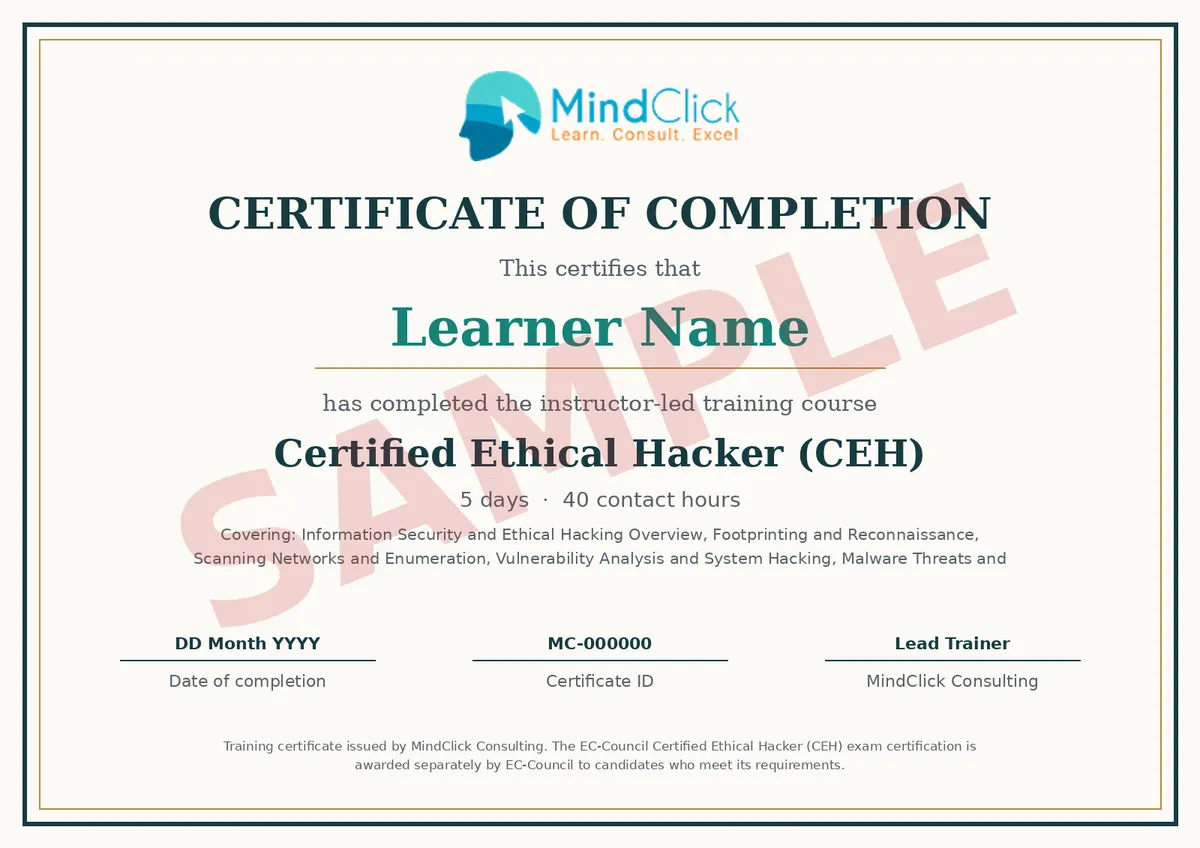
What you receive
You earn two separate credentials. The sample shows the MindClick training certificate.
- MindClick certificate of completion: 5 days, 40 contact hours, issued to every attendee who completes the course.
- EC-Council Certified Ethical Hacker (CEH) exam: issued by EC-Council when you meet its requirements and pass the exam.
Before you choose your learning route
Session timings are indicative; the trainer may adjust them for the group. Exam details reflect the awarding body’s published information at the time of writing; confirm the current version when you book.
EC-Council owns this certification scheme. MindClick provides training and exam preparation and is not an accredited or authorised partner of EC-Council.
Fees
| Delivery format | Fee per learner | Exam fee |
|---|---|---|
| Live online | $2,800 USD ≈ €2,485 |
Included |
| Classroom | $4,500 USD ≈ €3,995 |
Included |
Local amounts are indicative only, converted at the rate captured on 2026-10-02. You are charged in USD and your bank sets the final rate.
One awarding-body certification exam attempt is included in the training fee. Confirm the current fee, any applicable tax and what the fee covers in writing before you pay.
Prerequisites
- EC-Council permits CEH exam candidates who complete official training or who submit an eligibility application evidencing at least two years of information security work experience. Recommended: familiarity with TCP/IP, Windows/Linux command line, and basic networking and security concepts. Bring a laptop capable of running two VMs (8 GB+ RAM), with local admin rights, and a photo ID.
FIND YOUR START
Confirmed batch starts
Choose a published start, then review your offer in the same enrollment flow. A start date is not the full timetable or a seat reservation.
Choose your country & monthStarts
- Training location
- Frankfurt, Germany
- Local timezone
- Europe/Berlin
Joining details and full session timetable to be supplied.
Starts
- Training location
- Frankfurt, Germany
- Local timezone
- Europe/Berlin
Venue and full session timetable to be supplied.
Starts
- Training location
- Frankfurt, Germany
- Local timezone
- Europe/Berlin
Venue and full session timetable to be supplied.
Starts
- Training location
- Frankfurt, Germany
- Local timezone
- Europe/Berlin
Joining details and full session timetable to be supplied.
Starts
- Training location
- Frankfurt, Germany
- Local timezone
- Europe/Berlin
Joining details and full session timetable to be supplied.
Frequently asked questions
How long is the course?
5 days, 40 contact hours, normally 09:00 to 17:30 with breaks. The agenda follows the exam domains and the final day includes a mock exam.
What is the exam format?
EC-Council Certified Ethical Hacker (CEH) exam: 125 multiple-choice questions, 240 minutes, Closed book, Pearson VUE test centre or remote proctored via ECC Exam Centre. Pass mark: Varies by exam form. Confirm the current version with the awarding body when you book.
Is the exam included?
Yes. Outside India the fee includes one certification exam attempt. Retakes are booked and paid directly with the awarding body.
Are there prerequisites?
EC-Council permits CEH exam candidates who complete official training or who submit an eligibility application evidencing at least two years of information security work experience. Recommended: familiarity with TCP/IP, Windows/Linux command line, and basic networking and security concepts. Bring a laptop capable of running two VMs (8 GB+ RAM), with local admin rights, and a photo ID.
What certificate will I receive?
Two credentials. MindClick issues a certificate of completion for 40 contact hours to every attendee. EC-Council issues the EC-Council Certified Ethical Hacker (CEH) exam certification when you pass the exam and meet its requirements. 3 years; renew via EC-Council Continuing Education (ECE) credits and membership.
Is MindClick an accredited training partner for this certification?
MindClick provides training and exam preparation and is not an accredited or authorised partner of EC-Council; the CEH exam is administered by EC-Council via Pearson VUE test centres or its remote proctoring platform.
KEEP EXPLORING
More ways to move forward.
Related training from the course catalog.


Certified Information Systems Security Professional (CISSP)
Five-day course covering the eight CISSP domains with labs, case studies and daily exam practice to build confidence for certification.

CompTIA Security+
A 4-day course building Security+ skills through labs on threats, architecture, operations and governance, with daily exam practice.

Certified Information Security Manager (CISM)
Five-day course where learners practise information security governance, risk, programme delivery and incident response, with labs and exam prep.
CISA Exam Preparation
A 3-day course to review CISA domains, practise audit scenarios, and work through exam-style questions with feedback and a timed mock.