Certification preparation
Scrum Developer Skills and CSD Study Support
This two-day course builds practical Scrum developer skills through TDD, CI, refactoring, and team collaboration with coached exercises.
THE BIG PICTURE
About this course
Certified Scrum Developer (CSD) is a credential for software developers working in Scrum teams, awarded by Scrum Alliance. It recognises proficiency with agile engineering practices that support high-quality, incremental delivery. Across two days you practise test-driven development, continuous integration, version control workflows, refactoring, and collaborative techniques such as pair/mob programming. Hands-on labs, code katas, and peer reviews connect each technique to your team’s Definition of Done and working software. There is no standalone exam for CSD; the credential is earned by completing an approved Scrum Alliance CSD course with a qualified trainer. Certificates renew every two years by earning Scrum Education Units (SEUs) and paying a renewal fee. Scrum Alliance owns the certification scheme. MindClick provides training and exam preparation and is not an accredited or authorised partner.
What you’ll learn
- Apply the red–green–refactor cycle to implement a user story with fast, reliable unit tests
- Use test doubles, seams, and characterisation tests to work safely with legacy code
- Set up a CI pipeline that builds, tests, and reports feedback on each commit
- Select and use version control workflows (e.g., trunk-based or short-lived branches) with effective code reviews
- Identify code smells and refactor using common patterns to improve design and testability
- Facilitate collaborative development with pair/mob programming and align quality with a clear Definition of Done
- Design an approach for automated integration and end-to-end testing in a Scrum team context
- Plan your route to the CSD by selecting an approved course and understanding assessment and renewal steps
A CLEAR PATH FORWARD
2-day course agenda
2 instructor-led days (16 contact hours) mapped to the exam domains. Each day combines short concept sessions, hands-on practice on a running case study and exam-style questions.
- Learning route
- 2 recommended days
- Practical work
- 2 guided activities
- Finish with
- Mock exam + certification exam
Take a look at each day. Open a section to see the topics and practical work.
Day 1TDD foundations, collaboration, and CI essentialsTDD, collaboration practices, CI fundamentals, and Definition of Done
What we’ll cover
- 09:00–09:30 · Course goals, team working agreement, and baseline skills check
- 09:30–10:45 · Scrum developer collaboration, Definition of Done, and quality criteria
- 11:00–12:30 · Test-Driven Development: red–green–refactor cycle and unit testing patterns
- 13:30–14:45 · Test doubles, seams, and working with legacy code
- 15:00–16:00 · Continuous Integration: build automation, pipelines, and feedback
- 16:00–17:00 · Pair/mob programming kata with version control workflow
- 17:00–17:30 · Exam-style practice questions and debrief
Put it into practice
Implement a small user story in pairs using TDD, committing at each green step. Configure a simple CI job that builds and runs tests on each push.
You’ll take away
TDD and CI practice repository with working tests
Day 2Refactoring, automated testing, and CSD route planningRefactoring, automated integration testing, workflows, DoD, and credential preparation
What we’ll cover
- 09:00–09:20 · Recap of Day 1, Q&A, and plan for Day 2
- 09:20–10:45 · Refactoring patterns, code smells, and clean design for testability
- 11:00–12:15 · Automated integration and end-to-end testing; environments and test data management
- 12:15–12:45 · Version control workflows: trunk-based vs feature branching and code review practices
- 13:45–14:45 · Continuous Delivery basics and deployment strategies for Scrum teams
- 15:00–16:15 · Collaborative design: slicing stories and strengthening the Definition of Done
- 16:15–17:00 · Exam-style practice questions and personal action planning
- 17:00–17:30 · Mock exam-style quiz and guidance on enrolling in an approved CSD course and Scrum Alliance account setup
Put it into practice
Refactor a legacy module guided by tests to reduce code smells and improve design. Extend the CI pipeline to run integration tests and surface actionable feedback.
You’ll take away
Refactored code sample and personal CSD action plan
Bring it all together
Certification exam: Certified Scrum Developer (CSD), awarded by Scrum Alliance. Confirm the current exam format with the awarding body when you book. Validity: Renews every 2 years by earning Scrum Education Units (SEUs) and submitting a renewal fee.. Every attendee also receives a MindClick certificate of completion for 16 contact hours.
What you receive
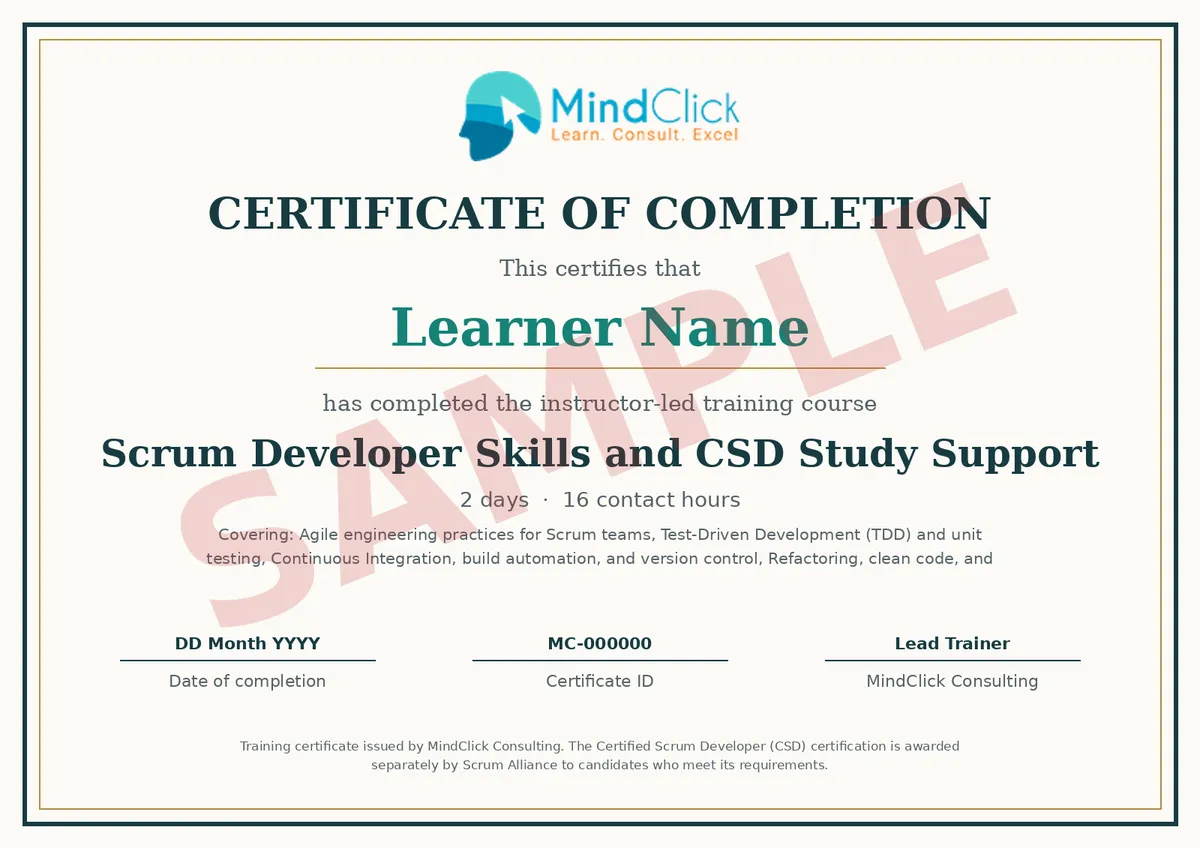
You earn two separate credentials. The sample shows the MindClick training certificate.
- MindClick certificate of completion: 2 days, 16 contact hours, issued to every attendee who completes the course.
- Certified Scrum Developer (CSD): issued by Scrum Alliance when you meet its requirements and pass the exam.
Before you choose your learning route
Certification route: This credential is earned by completing an approved Scrum Alliance CSD course with a qualified trainer; there is no standalone exam voucher.
Session timings are indicative; the trainer may adjust them for the group. Exam details reflect the awarding body’s published information at the time of writing; confirm the current version when you book.
Scrum Alliance owns this certification scheme. MindClick provides training and exam preparation and is not an accredited or authorised partner of Scrum Alliance.
Fees
| Delivery format | Fee per learner | Exam fee |
|---|---|---|
| Live online | $2,800 USD | Included |
| Classroom | $4,500 USD | Included |
One awarding-body certification exam attempt is included in the training fee. Confirm the current fee, any applicable tax and what the fee covers in writing before you pay.
Prerequisites
- There are no formal prerequisites for CSD, but practical experience with a programming language, unit testing, and Git is recommended. Bring a laptop with a configured development environment, Git client, and a unit testing framework for your chosen language.
Who is this course for?
- Professionals and teams evaluating this subject for their work.
FIND YOUR START
Confirmed batch starts
Choose a published start, then review your offer in the same enrollment flow. A start date is not the full timetable or a seat reservation.
Choose your country & monthStarts
- Training location
- Dubai, United Arab Emirates
- Local timezone
- Asia/Dubai
Joining details and full session timetable to be supplied.
Starts
- Training location
- Vienna, Austria
- Local timezone
- Europe/Vienna
Joining details and full session timetable to be supplied.
Starts
- Training location
- Sydney, Australia
- Local timezone
- Australia/Sydney
Joining details and full session timetable to be supplied.
Starts
- Training location
- Brussels, Belgium
- Local timezone
- Europe/Brussels
Joining details and full session timetable to be supplied.
Starts
- Training location
- Manama, Bahrain
- Local timezone
- Asia/Bahrain
Joining details and full session timetable to be supplied.
Starts
- Training location
- São Paulo, Brazil
- Local timezone
- America/Sao_Paulo
Joining details and full session timetable to be supplied.
Frequently asked questions
How long is the course?
2 days, 16 contact hours, normally 09:00 to 17:30 with breaks. The agenda follows the exam domains and the final day includes a mock exam.
Is the exam included?
Yes. Outside India the fee includes one certification exam attempt. Retakes are booked and paid directly with the awarding body. This credential is earned by completing an approved Scrum Alliance CSD course with a qualified trainer; there is no standalone exam voucher.
Are there prerequisites?
There are no formal prerequisites for CSD, but practical experience with a programming language, unit testing, and Git is recommended. Bring a laptop with a configured development environment, Git client, and a unit testing framework for your chosen language.
What certificate will I receive?
Two credentials. MindClick issues a certificate of completion for 16 contact hours to every attendee. Scrum Alliance issues the Certified Scrum Developer (CSD) certification when you pass the exam and meet its requirements. Renews every 2 years by earning Scrum Education Units (SEUs) and submitting a renewal fee..
Is MindClick an accredited training partner for this certification?
MindClick provides training and exam preparation and is not an accredited/authorised partner of Scrum Alliance; Scrum Alliance administers the credential through approved trainers and courses.
KEEP EXPLORING
More ways to move forward.
Related training from the course catalog.

Certified ScrumMaster (CSM)
A 2-day course (09:00–17:30) to apply Scrum roles, events, artefacts and servant leadership through scenarios, simulations and exam practice.

Professional Scrum Master (PSM I & II)
A 2-day course to apply Scrum in realistic scenarios, strengthen facilitation and coaching skills, and prepare for PSM I and PSM II exams.

AI-Empowered SAFe® Agilist (Leading SAFe)
A 2-day course to apply SAFe 6.0 at team, program and portfolio levels with hands-on AI exercises, PI Planning practice and exam preparation.
Agile Project Management with Scrum
A 3-day practical course where you apply Scrum to plan, deliver, and inspect work, manage backlogs, and run sprints with hands-on labs.