Certification preparation
Certified Kubernetes Administrator (CKA)
Five-day course where you build, configure and troubleshoot Kubernetes clusters through labs aligned to CKA domains with daily practice.
THE BIG PICTURE
About this course
The Certified Kubernetes Administrator (CKA) is a performance-based certification awarded by the Cloud Native Computing Foundation (CNCF) that validates practical skills in administering Kubernetes clusters. Across five days you will cover cluster architecture, installation and configuration, workloads and scheduling, services and networking, storage, and troubleshooting. Each topic is backed by guided labs, realistic scenarios, and daily exam-style practice to build speed and accuracy at the terminal. The CKA exam is an online, remotely proctored, hands-on test with approximately 15–20 performance-based tasks to complete in 120 minutes. It is open book with access to official Kubernetes documentation, the passing score is 66%, and the certification is valid for 3 years. The exam is delivered by The Linux Foundation on behalf of CNCF. Cloud Native Computing Foundation (CNCF) owns the certification scheme. MindClick provides training and exam preparation and is not an accredited or authorised partner.
What you’ll learn
- Install and configure a multi-node Kubernetes cluster with kubeadm and manage cluster lifecycle tasks
- Administer cluster components, kubeconfig, certificates, and perform etcd backups and restores
- Deploy and manage Pods, Deployments, DaemonSets, Jobs and CronJobs with controlled rollouts
- Apply scheduling controls using taints, tolerations, selectors, and affinity/anti-affinity rules
- Configure Services, Ingress and DNS and implement basic NetworkPolicies for traffic control
- Provision and consume storage with PersistentVolumes, PersistentVolumeClaims and StorageClasses
- Diagnose and resolve cluster and workload issues using logs, events, probes and kubectl debugging
- Practise exam-grade tasks and build a personal study plan to sit and pass the CKA exam
A CLEAR PATH FORWARD
5-day course agenda
5 instructor-led days (40 contact hours) mapped to the exam domains. Each day combines short concept sessions, hands-on practice on a running case study and exam-style questions.
- Learning route
- 5 recommended days
- Practical work
- 5 guided activities
- Finish with
- Mock exam + certification exam
Take a look at each day. Open a section to see the topics and practical work.
Day 1Cluster architecture, installation and configurationCluster Architecture, Installation & Configuration
What we’ll cover
- 09:00–10:30 · Kubernetes architecture: control plane and node components; API server, scheduler, controller manager, kubelet
- 10:45–12:30 · Cluster bring-up with kubeadm; container runtimes; kubeconfig contexts and certificates
- 13:30–14:45 · etcd basics; snapshot, restore and validation of cluster state
- 15:00–16:00 · Node management, labels and taints; cluster upgrades overview
- 16:00–16:45 · RBAC fundamentals: roles, role bindings and service accounts
- 16:45–17:30 · Exam-style practice tasks: kubeadm initialisation, node join and etcd backup
Put it into practice
Build a two-node lab cluster with kubeadm, join a worker and configure kubectl access. Take and verify an etcd snapshot, then restore to prove recovery.
You’ll take away
Cluster build and recovery checklist with kubeadm and etcd commands
Day 2Workloads and schedulingWorkloads & Scheduling
What we’ll cover
- 09:00–10:30 · Recap Day 1 and Q&A; Pods, Deployments and ReplicaSets; rollout strategies and rollback
- 10:45–12:30 · DaemonSets, Jobs and CronJobs; probes, lifecycle hooks and init containers
- 13:30–14:45 · Scheduling controls: taints/tolerations, nodeSelector, node/Pod affinity and anti-affinity
- 15:00–16:00 · Resource requests/limits, QoS classes, HPA and Pod disruption budgets
- 16:00–16:45 · Namespaces, labels/annotations and basic kustomize for manifests
- 16:45–17:30 · Exam-style practice tasks: workload rollouts, scheduling constraints and probe fixes
Put it into practice
Deploy a multi-tier app with health checks and roll it out safely. Enforce placement using taints and affinities, then validate with targeted failures.
You’ll take away
Reusable YAML library for common CKA workload objects
Day 3Services, networking and ingressServices & Networking
What we’ll cover
- 09:00–10:30 · Recap Day 2 and Q&A; Kubernetes networking model and CNI overview
- 10:45–12:30 · Services: ClusterIP, NodePort and LoadBalancer; service discovery and CoreDNS
- 13:30–14:45 · Ingress API concepts, controllers and TLS configuration
- 15:00–16:00 · NetworkPolicies: design, create and test traffic rules
- 16:00–16:45 · Troubleshooting networking: kube-proxy modes, DNS resolution and connectivity checks
- 16:45–17:30 · Exam-style practice tasks: Services, Ingress and NetworkPolicies
Put it into practice
Expose an application with a Service and Ingress, secure it with TLS and restrict traffic with a NetworkPolicy. Verify reachability and DNS resolution.
You’ll take away
Networking and Ingress configuration notes with test commands
Day 4Storage and cluster security essentialsStorage; Cluster configuration (security elements)
What we’ll cover
- 09:00–10:30 · Recap Day 3 and Q&A; PersistentVolumes and PersistentVolumeClaims
- 10:45–12:30 · StorageClasses and dynamic provisioning; StatefulSets basics
- 13:30–14:45 · Secrets and ConfigMaps; encryption at rest overview
- 15:00–16:00 · Security contexts, capabilities and PodSecurityAdmission
- 16:00–16:45 · Admission controllers, image sources and API access controls
- 16:45–17:30 · Exam-style practice tasks: storage provisioning and access controls
Put it into practice
Create a StorageClass and bind PVCs for a stateful workload, then migrate data safely. Apply security contexts and verify permissions in running Pods.
You’ll take away
Storage and security quick-reference (manifests and commands)
Day 5Troubleshooting and exam readinessTroubleshooting across all domains; exam skills and timing
What we’ll cover
- 09:00–10:30 · Recap Day 4 and Q&A; kubectl debug, logs, events and common error patterns
- 10:45–12:30 · Control plane and node troubleshooting: kubelet, certificates, DNS and networking
- 13:30–15:30 · Mock CKA exam (timed, performance-based task set)
- 15:45–16:30 · Mock review and remediation: faster approaches and command fluency
- 16:30–16:45 · Exam booking guidance, environment checks and documentation usage rules
- 16:45–17:30 · Final exam-style practice sprints and personal action planning
Put it into practice
Work through a broken-cluster scenario to restore control plane health, fix scheduling and recover a failing workload. Reflect on root causes and faster fixes.
You’ll take away
Troubleshooting runbook and personalised CKA study plan
Bring it all together
Certification exam: Certified Kubernetes Administrator (CKA), awarded by Cloud Native Computing Foundation (CNCF). 15–20 performance-based tasks, 120 minutes, open book (official Kubernetes documentation allowed), online proctored. Pass mark: 66%. Validity: 2 years for certifications earned since April 2024. Every attendee also receives a MindClick certificate of completion for 40 contact hours.
What you receive
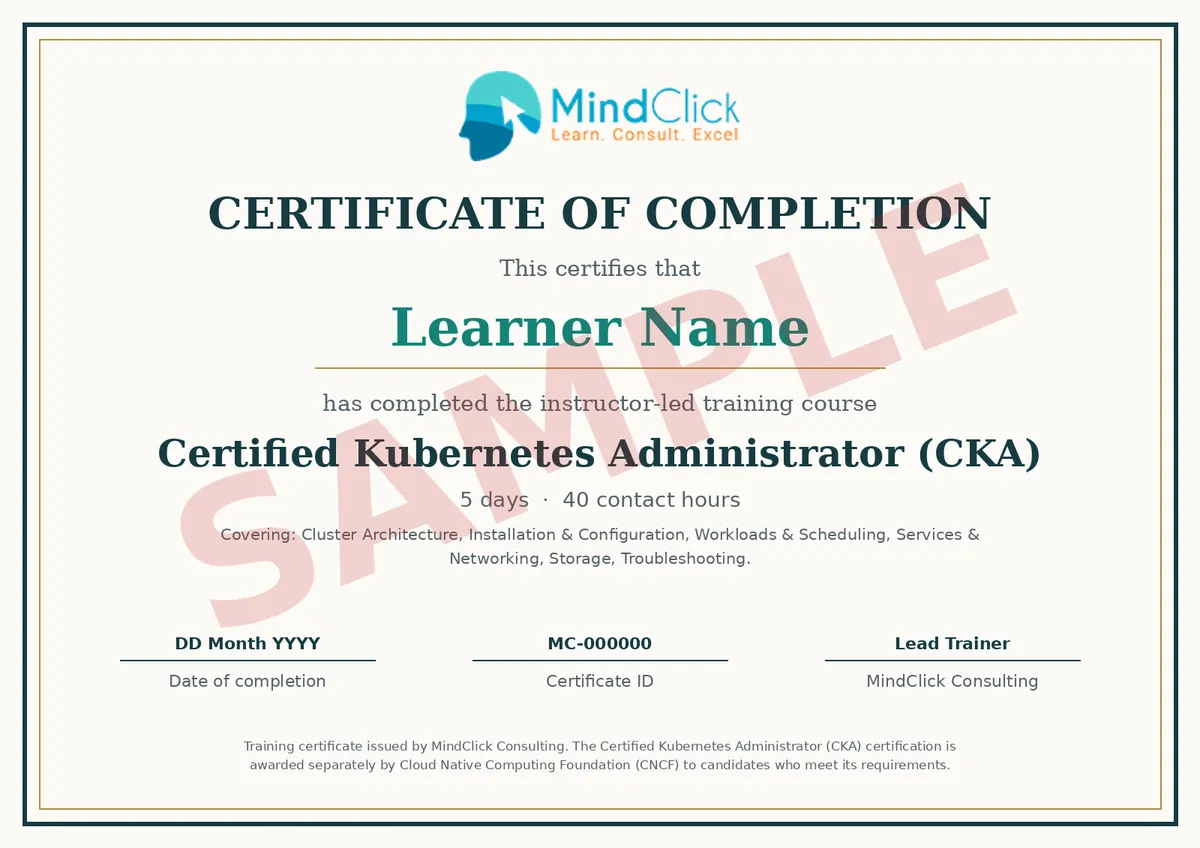
You earn two separate credentials. The sample shows the MindClick training certificate.
- MindClick certificate of completion: 5 days, 40 contact hours, issued to every attendee who completes the course.
- Certified Kubernetes Administrator (CKA): issued by Cloud Native Computing Foundation (CNCF) when you meet its requirements and pass the exam.
Before you choose your learning route
Session timings are indicative; the trainer may adjust them for the group. Exam details reflect the awarding body’s published information at the time of writing; confirm the current version when you book.
Cloud Native Computing Foundation (CNCF) owns this certification scheme. MindClick provides training and exam preparation and is not an accredited or authorised partner of Cloud Native Computing Foundation (CNCF).
Fees
| Delivery format | Fee per learner | Exam fee |
|---|---|---|
| Live online | $2,800 USD | Included |
| Classroom | $4,500 USD | Included |
One awarding-body certification exam attempt is included in the training fee. Confirm the current fee, any applicable tax and what the fee covers in writing before you pay.
Prerequisites
- No formal prerequisites from CNCF. Recommended: familiarity with Linux administration, containers, basic networking, and 6–12 months’ experience working with Kubernetes; comfort editing YAML and using the command line. Bring a laptop with admin rights, a modern browser, terminal/SSH, and stable internet; lab access is provided.
FIND YOUR START
Confirmed batch starts
Choose a published start, then review your offer in the same enrollment flow. A start date is not the full timetable or a seat reservation.
Choose your country & monthStarts
- Training location
- Dubai, United Arab Emirates
- Local timezone
- Asia/Dubai
Venue and full session timetable to be supplied.
Starts
- Training location
- Vienna, Austria
- Local timezone
- Europe/Vienna
Venue and full session timetable to be supplied.
Starts
- Training location
- Sydney, Australia
- Local timezone
- Australia/Sydney
Venue and full session timetable to be supplied.
Starts
- Training location
- Brussels, Belgium
- Local timezone
- Europe/Brussels
Venue and full session timetable to be supplied.
Starts
- Training location
- Manama, Bahrain
- Local timezone
- Asia/Bahrain
Venue and full session timetable to be supplied.
Starts
- Training location
- São Paulo, Brazil
- Local timezone
- America/Sao_Paulo
Venue and full session timetable to be supplied.
Frequently asked questions
How long is the course?
5 days, 40 contact hours, normally 09:00 to 17:30 with breaks. The agenda follows the exam domains and the final day includes a mock exam.
What is the exam format?
Certified Kubernetes Administrator (CKA): 15–20 performance-based tasks, 120 minutes, open book (official Kubernetes documentation allowed), online proctored. Pass mark: 66%. Confirm the current version with the awarding body when you book.
Is the exam included?
Yes. Outside India the fee includes one certification exam attempt. Retakes are booked and paid directly with the awarding body.
Are there prerequisites?
No formal prerequisites from CNCF. Recommended: familiarity with Linux administration, containers, basic networking, and 6–12 months’ experience working with Kubernetes; comfort editing YAML and using the command line. Bring a laptop with admin rights, a modern browser, terminal/SSH, and stable internet; lab access is provided.
What certificate will I receive?
Two credentials. MindClick issues a certificate of completion for 40 contact hours to every attendee. Cloud Native Computing Foundation (CNCF) issues the Certified Kubernetes Administrator (CKA) certification when you pass the exam and meet its requirements. 2 years for certifications earned since April 2024.
Is MindClick an accredited training partner for this certification?
MindClick provides training and exam preparation and is not an accredited/authorised partner of the Cloud Native Computing Foundation (CNCF). The exam is administered by The Linux Foundation on behalf of CNCF.
KEEP EXPLORING
More ways to move forward.
Related training from the course catalog.


ITIL 4 Foundation Certification
Two-day course covering ITIL 4 Foundation essentials with scenario-based activities and exam practice to prepare you to sit the certification.
DevOps Foundation Certification
Two-day course on DevOps culture, principles and practices with hands-on mapping and pipeline design, plus preparation for the DevOps Foundation exam.
ITIL 4 Managing Professional
Ten days of hands-on study across ITIL 4 CDS, DSV, HVIT and DPI, with labs and daily exam practice towards the Managing Professional designation.
ITIL Create Deliver and Support Preparation
A 3-day course to map service value streams, apply ITIL 4 CDS practices across design, build and support, and rehearse exam questions with a mock.