Certification preparation
AI-Empowered SAFe® Product Owner/Product Manager (POPM)
Two-day AI-Empowered SAFe POPM training: PI Planning, ART and Team Backlogs, iteration execution and AI for product roles, with a mock exam.
THE BIG PICTURE
About this course
AI-Empowered SAFe® Product Owner/Product Manager (POPM) is the Scaled Agile, Inc. certification for people who own the Team Backlog (Product Owners) or the ART Backlog and roadmap (Product Managers) on an Agile Release Train. The current version adds a full exam domain on applying AI to product roles. This 2-day, 16-hour course follows the six published exam domains: POPM roles and responsibilities; PI Planning preparation; leadership in PI Planning; iteration execution; PI execution; and applying AI to product roles. You work on one ART case study throughout. You write Features and Stories, prioritise with WSJF, run a PI Planning breakout, and use an AI assistant for backlog refinement, personas and stakeholder updates, checking each output against responsible-AI practice. The exam is timed and multiple-choice, takes 90 minutes and is taken online through the SAFe Community Platform. Scaled Agile publishes the pass mark as 82%. You keep the credential by earning at least 12 CEUs a year. Scaled Agile, Inc. owns the SAFe certification scheme. MindClick provides training and exam preparation and is not a Scaled Agile partner.
What you’ll learn
- Describe the Product Owner and Product Manager responsibilities in SAFe and how they relate to the Lean-Agile mindset and value streams.
- Prepare for PI Planning: communicate the Solution Vision, forecast with roadmaps, write Features with benefit hypotheses and manage the ART Backlog and ART Kanban.
- Lead in PI Planning: present the vision, plan PI Objectives, organise dependencies and analyse risks with ROAM.
- Run iteration execution: create Stories with acceptance criteria, plan iterations, manage flow with the Team Kanban, refine the Team Backlog and take part in Iteration Review and Retrospective.
- Support DevOps and Release on Demand, take part in the PO Sync and System Demo, use the IP Iteration for innovation, and contribute to Inspect and Adapt.
- Apply AI to product roles: AI basics and terminology, effective prompting, responsible AI use and protecting sensitive data, and using AI for backlog refinement, prioritisation, feature discovery, personas and stakeholder communication.
- Build a personal AI integration plan with prompts you can reuse for Features and Stories.
- Prepare for the AI-Empowered SAFe POPM exam with domain-weighted practice and a timed mock exam.
A CLEAR PATH FORWARD
2-day AI-Empowered SAFe POPM agenda
Two instructor-led days (16 contact hours) mapped to the six domains of the current AI-Empowered SAFe POPM exam, including the new Apply AI to Product Roles domain. Each day combines short concept sessions, hands-on work on one Agile Release Train (ART) case study and exam-style questions.
- Learning route
- 2 recommended days
- Practical work
- 2 guided activities
- Finish with
- Mock exam + POPM exam
Take a look at each day. Open a section to see the topics and practical work.
Day 1POPM roles, preparing for and leading PI PlanningExam domains: Roles and Responsibilities (12–14%), PI Planning Preparation (17–19%), Leadership for PI Planning (14–16%)
What we’ll cover
- 09:00–09:30 · Welcome, course goals, exam structure and domain weightings
- 09:30–10:30 · Applying SAFe to the PO and PM roles: Lean-Agile mindset, value streams, PO and PM responsibilities on the ART
- 10:45–11:45 · Summarise PI Planning; explain the Solution Vision; forecast work through roadmaps
- 11:45–12:30 · Planning Features: benefit hypotheses, acceptance criteria, Enablers; managing the ART Backlog and ART Kanban; WSJF prioritisation
- 13:30–14:30 · Communicate the vision in PI Planning; plan and write PI Objectives with business value
- 14:30–15:30 · Organise and manage dependencies (ART planning board); analyse risks with ROAM
- 15:45–16:45 · PI Planning simulation on the case study: draft plans, objectives, dependencies and risks
- 16:45–17:30 · Exam-style questions on Day 1 domains and day review
Put it into practice
Using the ART case study, refine the vision into a short roadmap, write three Features with benefit hypotheses and acceptance criteria, rank them with WSJF, then run a short PI Planning breakout that produces PI Objectives, a dependency map and a ROAMed risk list.
You’ll take away
Prioritised Feature set with WSJF scores, draft PI Objectives and a ROAMed risk list
Day 2Iteration and PI execution, and applying AI to product rolesExam domains: Iteration Execution (28–30%), PI Execution (10–12%), Apply AI to Product Roles (12–14%)
What we’ll cover
- 09:00–09:15 · Day 1 recap
- 09:15–10:30 · Creating Stories (user and enabler), splitting and acceptance criteria; planning an iteration; managing flow with the Team Kanban
- 10:45–11:45 · Refining the Team Backlog; taking part in the Iteration Review and Retrospective; supporting DevOps and Release on Demand
- 11:45–12:30 · PI Execution: PO Sync, System Demo, innovation and the IP Iteration, Inspect and Adapt
- 13:30–14:30 · Apply AI to product roles (1): AI basics and terminology, prompting techniques, risks and responsible AI use, protecting sensitive data
- 14:30–15:15 · Apply AI to product roles (2): AI for backlog refinement, prioritisation, feature discovery, customer personas and stakeholder communication; SAFe CoPilot overview
- 15:30–16:30 · Timed mock exam weighted to the six exam domains, with answer walkthrough
- 16:30–17:30 · Personal AI integration plan, exam access and booking, CEU renewal, final Q&A
Put it into practice
Use an AI assistant to split one Feature into Stories with acceptance criteria and draft a persona and a stakeholder update. Then review every output against a responsible-AI checklist (accuracy, bias, data sensitivity) and correct it by hand.
You’ll take away
AI-assisted Story set with review notes, and a personal AI integration plan with reusable prompts
Bring it all together
Certification exam: AI-Empowered SAFe® Product Owner/Product Manager (POPM), awarded by Scaled Agile, Inc. Timed, multiple-choice, 90 minutes, taken online through the SAFe Community Platform. Scaled Agile publishes the pass mark as 82%. Exam domains and weightings: Roles and Responsibilities 12–14%, PI Planning Preparation 17–19%, Leadership for PI Planning 14–16%, Iteration Execution 28–30%, PI Execution 10–12%, Apply AI to Product Roles 12–14%. To keep the credential you earn at least 12 Continuing Education Units (CEUs) a year. Every attendee also receives a MindClick certificate of completion for 16 contact hours.
What you receive
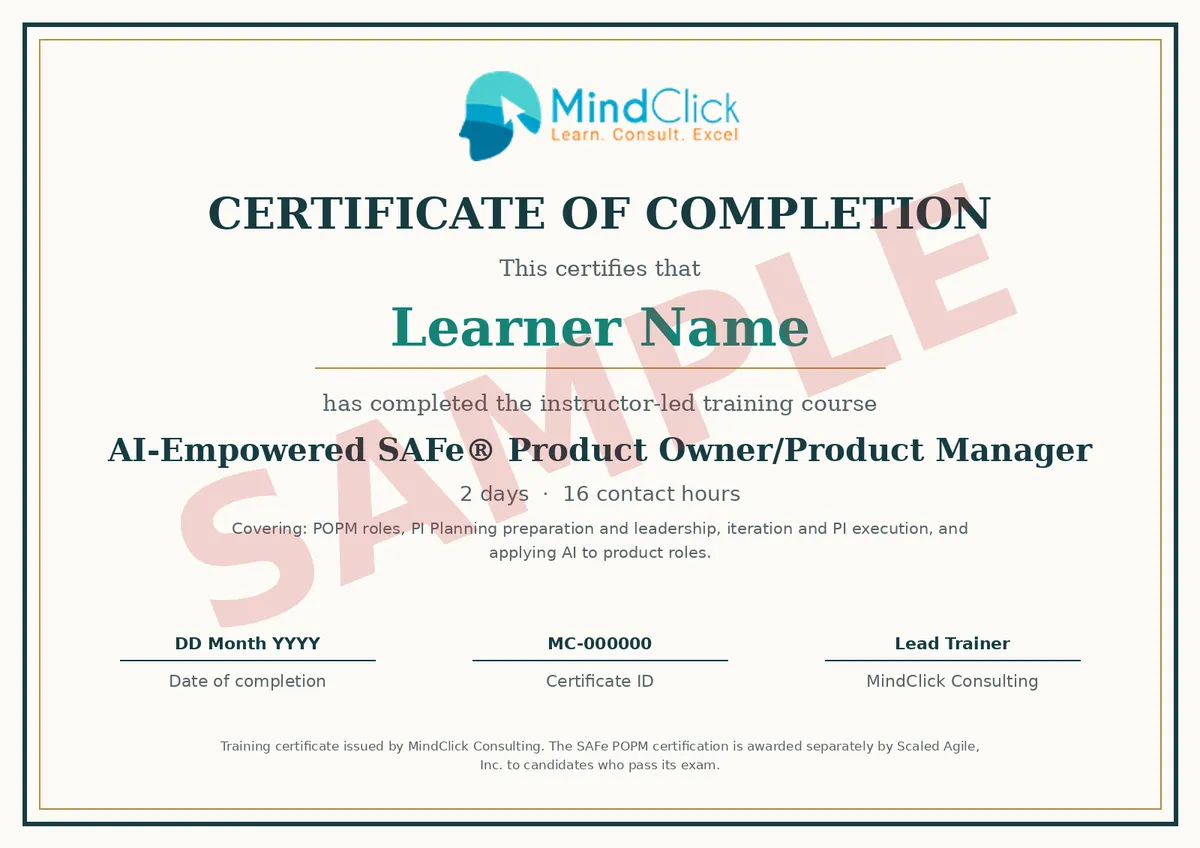
You earn two separate credentials. The sample shows the MindClick training certificate.
- MindClick certificate of completion: 2 days, 16 contact hours, issued to every attendee who completes the course.
- AI-Empowered SAFe POPM certification and digital badge: issued by Scaled Agile, Inc. when you pass the exam.
- Keep it active by earning at least 12 CEUs a year, as Scaled Agile requires.
Before you choose your learning route
Content follows the exam guidelines that Scaled Agile publishes for the AI-Empowered SAFe POPM certification (SAFe 6.0 terminology: ART Backlog, Team Backlog, PI Objectives). Session timings are indicative.
Scaled Agile, Inc. owns the SAFe certification scheme. Scaled Agile states its licensed SAFe courses are taught by certified SAFe Practice Consultants (SPCs). MindClick provides training and exam preparation and is not a Scaled Agile partner, so this is not the licensed Scaled Agile courseware. Confirm your exam access route with an advisor before you book.
Scaled Agile's certification page currently marks a certification training course as not required to sit the exam. The page also states the AI-Empowered update is available in selected languages only.
Fees
| Delivery format | Fee per learner | Exam fee |
|---|---|---|
| Live online | $2,800 USD | Included |
| Classroom | $4,500 USD | Included |
One awarding-body certification exam attempt is included in the training fee. Confirm the current fee, any applicable tax and what the fee covers in writing before you pay.
Prerequisites
- No formal prerequisites. Familiarity with Agile and Scrum and some experience of product, business-analysis or delivery work helps. Bring a laptop and access to a generative AI assistant your organisation allows. Use sample data only during the AI exercises.
Who is this course for?
- Professionals and teams evaluating this subject for their work.
FIND YOUR START
Confirmed batch starts
Choose a published start, then review your offer in the same enrollment flow. A start date is not the full timetable or a seat reservation.
Choose your country & month$4,500 USDClassroom · per learner · exam fee included
- Training location
- Dubai, United Arab Emirates
- Local timezone
- Asia/Dubai
Venue and full session timetable to be supplied.
$4,500 USDClassroom · per learner · exam fee included
- Training location
- Dubai, United Arab Emirates
- Local timezone
- Asia/Dubai
Venue and full session timetable to be supplied.
Starts
- Training location
- Dubai, United Arab Emirates
- Local timezone
- Asia/Dubai
Venue and full session timetable to be supplied.
Starts
- Training location
- Vienna, Austria
- Local timezone
- Europe/Vienna
Venue and full session timetable to be supplied.
Starts
- Training location
- Sydney, Australia
- Local timezone
- Australia/Sydney
Venue and full session timetable to be supplied.
Starts
- Training location
- Brussels, Belgium
- Local timezone
- Europe/Brussels
Venue and full session timetable to be supplied.
Frequently asked questions
How long is the course?
2 days, 16 contact hours, 09:00 to 17:30 with breaks. Day 1 covers roles and PI Planning. Day 2 covers iteration and PI execution, applying AI to product roles, and a timed mock exam.
What is the AI-Empowered SAFe POPM exam format?
Timed, multiple-choice, 90 minutes, online through the SAFe Community Platform. Scaled Agile publishes the pass mark as 82%. Domains: Roles and Responsibilities 12–14%, PI Planning Preparation 17–19%, Leadership for PI Planning 14–16%, Iteration Execution 28–30%, PI Execution 10–12%, Apply AI to Product Roles 12–14%.
What changed in the AI-Empowered version?
Scaled Agile added an exam domain, Apply AI to Product Roles, worth 12–14% of the exam. It covers AI basics and terminology, prompting, risks and responsible AI use, and using AI for backlog refinement, prioritisation, feature discovery, personas and stakeholder communication. This course gives it a dedicated afternoon on Day 2.
Are there prerequisites?
No formal prerequisites. Agile or Scrum familiarity and some product or delivery experience help. Bring a laptop and access to a generative AI assistant your organisation allows.
How do I keep the certification?
Scaled Agile requires at least 12 Continuing Education Units (CEUs) a year to maintain the POPM credential.
Is this the licensed Scaled Agile course?
No. Scaled Agile states its licensed SAFe courses are taught by certified SAFe Practice Consultants. MindClick is not a Scaled Agile partner. This is independent training and exam preparation mapped to the published exam guidelines. Confirm your exam access route with an advisor before you book.
What certificate will I receive?
MindClick issues a certificate of completion for 16 contact hours to every attendee. Scaled Agile, Inc. issues the AI-Empowered SAFe POPM certification and digital badge when you pass its exam.
KEEP EXPLORING
More ways to move forward.
Related training from the course catalog.


Certified ScrumMaster (CSM)
A 2-day course (09:00–17:30) to apply Scrum roles, events, artefacts and servant leadership through scenarios, simulations and exam practice.

Professional Scrum Master (PSM I & II)
A 2-day course to apply Scrum in realistic scenarios, strengthen facilitation and coaching skills, and prepare for PSM I and PSM II exams.

AI-Empowered SAFe® Agilist (Leading SAFe)
A 2-day course to apply SAFe 6.0 at team, program and portfolio levels with hands-on AI exercises, PI Planning practice and exam preparation.
Agile Project Management with Scrum
A 3-day practical course where you apply Scrum to plan, deliver, and inspect work, manage backlogs, and run sprints with hands-on labs.