Professional skills
Design Thinking Methodology (DTMethod®)
A 3-day course where you apply design thinking end-to-end with hands-on research, ideation, prototyping, user testing and implementation planning.
THE BIG PICTURE
About this course
Design Thinking Methodology (DTMethod®) is a certification awarded by APMG International. It recognises practical capability in applying human-centred design to improve services, products and processes. Over three days you work through the full cycle: empathise, define, ideate, prototype and test. You will practise interviews and observation, mapping insights, framing problems, running structured ideation, building low-fidelity prototypes, conducting quick user walkthroughs, and planning adoption and measurement. Activities are team-based using realistic cases, with reusable templates and facilitation tips. The course includes structured exam preparation and guidance on booking your assessment with APMG International or an APMG Accredited Training Organisation. Exam format, timing and pass marks are set by APMG International; please refer to the current candidate guidance for the latest details. APMG International owns the certification scheme. MindClick provides training and exam preparation and is not an accredited or authorised partner.
What you’ll learn
- Explain human-centred design principles and when to use them
- Plan and run empathetic user research and synthesise insights into personas and journey maps
- Frame design challenges, value propositions and success criteria
- Generate and select ideas using structured ideation and evaluation techniques
- Create low-fidelity prototypes, plan and conduct user tests, and iterate from feedback
- Facilitate collaborative workshops and engage stakeholders responsibly
- Outline implementation experiments, adoption considerations and measurement approaches
- Prepare effectively for the certification exam with practice questions and a timed mock
A CLEAR PATH FORWARD
3-day Design Thinking Methodology (DTMethod®) agenda
3 instructor-led days (24 contact hours) mapped to the exam domains. Each day combines short concept sessions, hands-on practice on a running case study and exam-style questions.
- Learning route
- 3 recommended days
- Practical work
- 3 guided activities
- Finish with
- Mock exam + certification exam
Take a look at each day. Open a section to see the topics and practical work.
Day 1Empathy and Problem FramingHuman-centred principles, empathy research, insight synthesis, problem framing
What we’ll cover
- 09:00–09:30 · Introductions, course objectives, exam overview and logistics
- 09:30–10:30 · Human‑centred design principles, values and ethics
- 10:45–12:30 · Planning and conducting user research (interviews and observation)
- 13:30–14:45 · Synthesising insights: personas, journey maps and pain‑gain grids
- 15:00–16:00 · Problem framing: How Might We, assumptions and success criteria
- 16:00–17:00 · Exam‑style practice questions and group rationales
- 17:00–17:30 · Day 1 debrief and backlog setup for Day 2
Put it into practice
In teams, conduct a short interview based on a provided case and capture observations. Map the journey and draft two problem statements with measurable outcomes.
You’ll take away
Research notes, journey map and problem statements
Day 2Ideation and PrototypingIdeation techniques, concept selection, low‑fidelity prototyping, facilitation
What we’ll cover
- 09:00–09:20 · Recap of Day 1 and learning reflections
- 09:20–10:30 · Divergent thinking: brainwriting, SCAMPER and creativity constraints
- 10:45–12:30 · Converging and selecting: dot voting, impact/effort and concept sheets
- 13:30–14:30 · Prototyping levels and tools; designing rapid experiments
- 14:30–15:30 · Building low‑fidelity prototypes (paper, storyboard, clickable stubs)
- 15:45–16:45 · Quick user walkthroughs; capturing feedback and insights
- 16:45–17:15 · Exam‑style practice questions and review
- 17:15–17:30 · Day 2 wrap‑up and preparation for Day 3
Put it into practice
Create two alternative low‑fidelity prototypes for the chosen concept. Test them with a peer team and capture actionable feedback for iteration.
You’ll take away
Prototype sketches and test findings
Day 3Testing, Iteration and ImplementationUser testing, iteration, implementation planning, measurement, stakeholder engagement
What we’ll cover
- 09:00–09:15 · Recap of Days 1–2 and plan for the day
- 09:15–10:30 · Structuring usability tests and learning loops; reducing bias
- 10:45–12:00 · Iterating concepts and documenting design decisions
- 12:00–12:30 · Measuring value: hypotheses, metrics and success criteria
- 13:30–14:30 · Planning pilots, change adoption and stakeholder engagement
- 14:30–15:30 · Communicating outcomes: service blueprints, storyboards and roadmaps
- 15:45–16:30 · Mock exam (timed) and self‑marking with rationales
- 16:30–17:10 · Exam booking guidance and candidate guidance walkthrough
- 17:10–17:30 · Personal action plan and course close
Put it into practice
Iterate your prototype based on structured test results and prepare an implementation canvas. Present your plan and receive peer critique.
You’ll take away
Implementation canvas and refined prototype
Bring it all together
Certification exam: Design Thinking Methodology (DTMethod®), awarded by APMG International. Confirm the current exam format with the awarding body when you book. Every attendee also receives a MindClick certificate of completion for 24 contact hours.
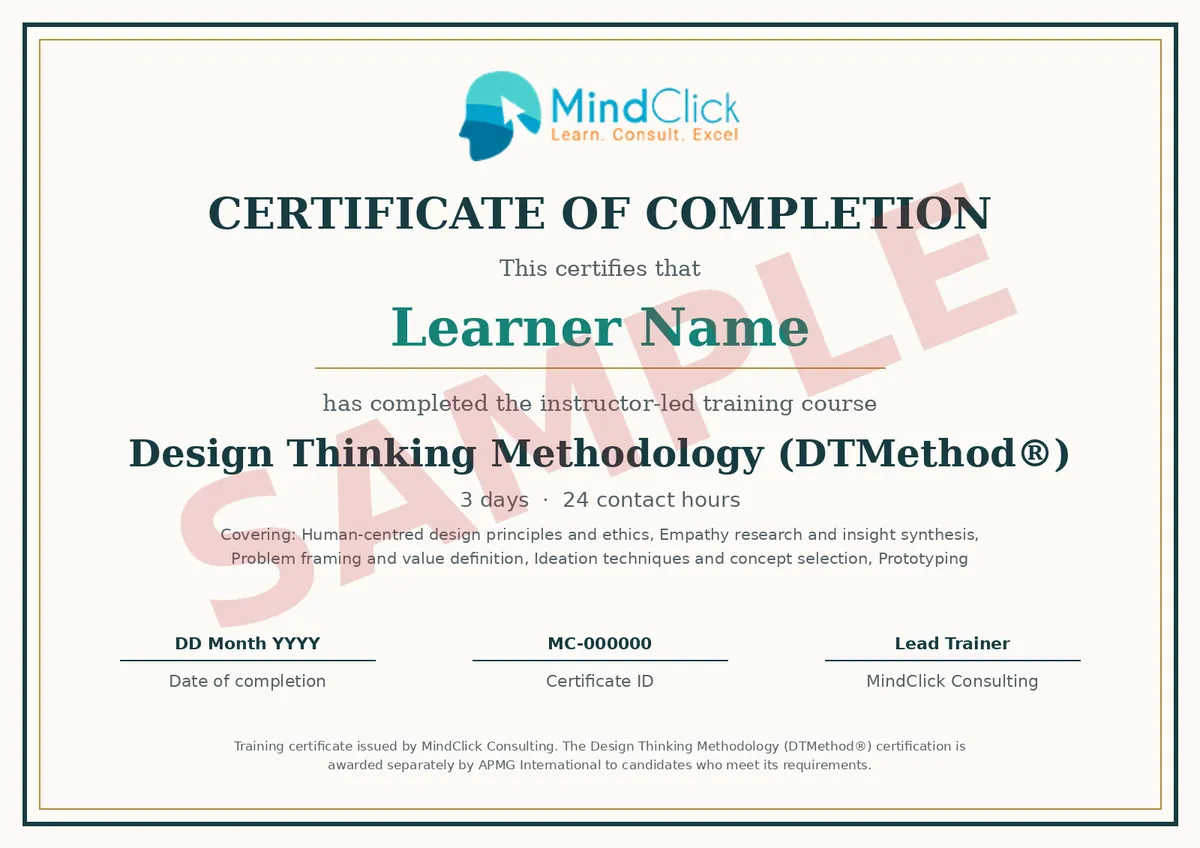
What you receive
You earn two separate credentials. The sample shows the MindClick training certificate.
- MindClick certificate of completion: 3 days, 24 contact hours, issued to every attendee who completes the course.
- Design Thinking Methodology (DTMethod®): issued by APMG International when you meet its requirements and pass the exam.
Before you choose your learning route
Session timings are indicative; the trainer may adjust them for the group. Exam details reflect the awarding body’s published information at the time of writing; confirm the current version when you book.
APMG International owns this certification scheme. MindClick provides training and exam preparation and is not an accredited or authorised partner of APMG International.
Fees
| Delivery format | Fee per learner | Exam fee |
|---|---|---|
| Live online | $2,800 USD | Included |
| Classroom | $4,500 USD | Included |
One awarding-body certification exam attempt is included in the training fee. Confirm the current fee, any applicable tax and what the fee covers in writing before you pay.
Prerequisites
- No formal prerequisites are stated by the awarding body. Experience in product, service, UX, business analysis, or change is helpful; bring a laptop with a modern browser (templates provided).
Who is this course for?
- Project/Product Managers seeking creative solutions to challenges.
- Those interested in standardized innovation processes and ways to improve current methods, i.e. business analysts or Scrum masters.
- Change Agents.
- Facilitators.
- Product Designers.
- Product Owners.
FIND YOUR START
Confirmed batch starts
Choose a published start, then review your offer in the same enrollment flow. A start date is not the full timetable or a seat reservation.
Choose your country & monthStarts
- Training location
- Dubai, United Arab Emirates
- Local timezone
- Asia/Dubai
Joining details and full session timetable to be supplied.
Starts
- Training location
- Vienna, Austria
- Local timezone
- Europe/Vienna
Joining details and full session timetable to be supplied.
Starts
- Training location
- Sydney, Australia
- Local timezone
- Australia/Sydney
Joining details and full session timetable to be supplied.
Starts
- Training location
- Brussels, Belgium
- Local timezone
- Europe/Brussels
Joining details and full session timetable to be supplied.
Starts
- Training location
- Manama, Bahrain
- Local timezone
- Asia/Bahrain
Joining details and full session timetable to be supplied.
Starts
- Training location
- São Paulo, Brazil
- Local timezone
- America/Sao_Paulo
Joining details and full session timetable to be supplied.
Frequently asked questions
How long is the course?
3 days, 24 contact hours, normally 09:00 to 17:30 with breaks. The agenda follows the exam domains and the final day includes a mock exam.
Is the exam included?
Yes. Outside India the fee includes one certification exam attempt. Retakes are booked and paid directly with the awarding body.
What does this course cost?
Outside India this 3-day course is listed at USD 2,800 per learner for live online delivery and USD 4,500 for classroom delivery. Both fees include one certification exam attempt. Pricing for India is confirmed separately by an advisor. Taxes and the final offer are confirmed in writing before you pay.
Are there prerequisites?
No formal prerequisites are stated by the awarding body. Experience in product, service, UX, business analysis, or change is helpful; bring a laptop with a modern browser (templates provided).
What certificate will I receive?
Two credentials. MindClick issues a certificate of completion for 24 contact hours to every attendee. APMG International issues the Design Thinking Methodology (DTMethod®) certification when you pass the exam and meet its requirements.
Is MindClick an accredited training partner for this certification?
MindClick provides training and exam preparation and is not an accredited or authorised partner of APMG International; the exam is administered by APMG International and its Accredited Training Organisations.
Where is classroom training delivered?
Singapore and Dubai are the priority classroom markets for this catalog. Classroom delivery is also available in the other listed countries, and live online delivery is available everywhere. Venues are confirmed per booking; a listed city is a training market, not an owned campus.
KEEP EXPLORING
More ways to move forward.
Related training from the course catalog.

Five Case Solution (5CS)
Three days of guided practice building a full Five Case business case in an online platform, collaborating in teams and trying exam-style tasks.
Adaptive Kanban Framework Certification
Three-day course to apply an adaptive Kanban approach in projects and operations through hands-on practice, simulations and exam preparation.
Agile Business Analysis (AgileBA) Certification
A 3-day course to apply agile business analysis techniques through case-based exercises and exam practice, preparing for Foundation/Practitioner.
Agile Change Certifications
Three-day course covering agile-led change principles and practice, with hands-on tools and coaching drills to prepare for Agile Change exams.