Professional skills
Lean Six Sigma Black Belt
10-day course where learners lead DMAIC projects, apply Lean tools and advanced statistics, and practise exam-style questions for Black Belt.
THE BIG PICTURE
About this course
Lean Six Sigma Black Belt is a senior-level credential recognised across industries for leading complex improvement projects and developing organisational capability. It is offered by several awarding bodies, including ASQ, IASSC and the Council for Six Sigma Certification. Across 10 days (80 hours), you will plan and lead improvement projects, quantify problems with data, and use advanced analytical and Lean methods to find and implement solutions. Hands-on work includes MSA and capability in software, hypothesis testing, regression, DOE, control charts, and creating control plans and handover packages. This course prepares you for recognised Lean Six Sigma Black Belt exams. Exams are booked directly with your chosen awarding body; formats vary by body and are typically proctored, computer-based and mapped to the DMAIC body of knowledge, with some bodies also requiring a completed project. Your instructor will provide guidance on selecting an exam route and booking. The awarding body owns the certification scheme. MindClick provides training and exam preparation and is not an accredited or authorised partner.
What you’ll learn
- Select and scope Black Belt projects aligned to strategy and customer needs
- Lead cross-functional teams and facilitate improvement workshops
- Plan data collection, conduct MSA, and evaluate process capability
- Apply hypothesis testing, ANOVA and regression to identify root causes
- Design and analyse screening and factorial experiments to optimise performance
- Implement Lean improvements and design robust control plans with SPC
- Quantify benefits, manage change, and close projects effectively
- Prepare for a chosen Black Belt exam with practice tests and exam techniques
A CLEAR PATH FORWARD
10-day Lean Six Sigma Black Belt agenda
10 instructor-led days (80 contact hours) mapped to the exam domains. Each day combines short concept sessions, hands-on practice on a running case study and exam-style questions.
- Learning route
- 10 recommended days
- Practical work
- 10 guided activities
- Finish with
- Mock exam + certification exam
Take a look at each day. Open a section to see the topics and practical work.
Day 1Black Belt role, deployment and project selectionLeadership and organisational deployment; Define phase
What we’ll cover
- 09:00–09:30 · Welcome, course orientation, objectives and assessment approach
- 09:30–10:45 · Lean and Six Sigma principles, DMAIC and the Black Belt role
- 11:00–12:30 · Organisational deployment, governance, roles and responsibilities
- 13:30–14:45 · Project selection, business case, voice of the business and benefits
- 15:00–16:15 · Project charters, stakeholders, change readiness and risk
- 16:15–17:30 · Exam-style practice questions and debrief
Put it into practice
Draft a project charter and stakeholder map for a chosen improvement opportunity. Peer review to refine the problem statement, scope and CTQs.
You’ll take away
Project charter and stakeholder map
Day 2Define: VOC to CTQ, SIPOC and high-level mappingDefine phase; Team management and facilitation
What we’ll cover
- 09:00–09:30 · Recap and Q&A from Day 1
- 09:30–10:45 · Voice of the Customer, CTQ trees and Kano considerations
- 11:00–12:30 · SIPOC development and boundaries; scoping workshop techniques
- 13:30–14:45 · High-level process mapping and swimlanes
- 15:00–16:15 · Risk assessment (COPQ, high-level FMEA) and communication plan
- 16:15–17:30 · Exam-style practice questions and debrief
Put it into practice
Build a SIPOC and CTQ tree for the selected project using customer inputs. Facilitate a short scoping session to validate boundaries and handoffs.
You’ll take away
SIPOC diagram and CTQ tree
Day 3Measure: data planning, sampling and MSA fundamentalsMeasure phase (data, MSA, capability)
What we’ll cover
- 09:00–09:30 · Recap and Q&A from Day 2
- 09:30–10:45 · Data types, operational definitions and sampling strategies
- 11:00–12:30 · Measurement System Analysis overview and planning
- 13:30–14:45 · Gage R&R (variable) study design and interpretation
- 15:00–16:15 · Attribute agreement analysis and tips for difficult measures
- 16:15–17:30 · Exam-style practice questions and debrief
Put it into practice
Plan and simulate an MSA (variable or attribute) using sample data in Minitab/Excel. Interpret results and decide on next steps to improve measurement.
You’ll take away
MSA plan and initial study results
Day 4Measure: capability analysis and SPC foundationsMeasure phase (capability) and Control phase (SPC basics)
What we’ll cover
- 09:00–09:30 · Recap and Q&A from Day 3
- 09:30–10:45 · Distribution assessment and data transformations
- 11:00–12:30 · Process capability indices (Cp, Cpk, Pp, Ppk) and confidence
- 13:30–14:45 · Short-run capability, non-normal data and performance metrics
- 15:00–16:15 · SPC chart selection and building X̄-R, I-MR and p/np charts
- 16:15–17:30 · Exam-style practice questions and debrief
Put it into practice
Generate capability reports and basic control charts from a real or provided dataset. Present baseline performance and key risks to stakeholders.
You’ll take away
Capability report and baseline SPC charts
Day 5Analyse: exploratory analysis and hypothesis testingAnalyse phase (hypothesis testing, ANOVA)
What we’ll cover
- 09:00–09:30 · Recap and Q&A from Day 4
- 09:30–10:45 · Exploratory data analysis, stratification and visualisation
- 11:00–12:30 · Hypothesis testing concepts, errors, power and sample size
- 13:30–14:45 · t-tests and confidence intervals (1-sample, 2-sample, paired)
- 15:00–16:15 · One-way ANOVA and multiple comparisons; non-normal options
- 16:15–17:30 · Exam-style practice questions and debrief
Put it into practice
Run t-tests and ANOVA on a provided dataset to test suspected factors. Interpret p-values, effect sizes and assumptions to form conclusions.
You’ll take away
Hypothesis testing analysis pack
Day 6Analyse: regression, nonparametrics and root causeAnalyse phase (regression and diagnostics)
What we’ll cover
- 09:00–09:30 · Recap and Q&A from Day 5
- 09:30–10:45 · Correlation, simple and multiple regression; model selection
- 11:00–12:30 · Residual analysis, transformations and multicollinearity
- 13:30–14:45 · Logistic regression overview and when to use it
- 15:00–16:15 · Nonparametric tests (Mann–Whitney, Kruskal–Wallis, Chi-square)
- 16:15–17:30 · Exam-style practice questions and debrief
Put it into practice
Build and diagnose a multiple regression model to quantify drivers of performance. Use outputs to prioritise factors for experimentation or redesign.
You’ll take away
Regression model workbook and insights
Day 7Improve: DOE screening and factorialsImprove phase (DOE and optimisation)
What we’ll cover
- 09:00–09:30 · Recap and Q&A from Day 6
- 09:30–10:45 · DOE concepts, effect hierarchy and resolution
- 11:00–12:30 · Screening designs (Plackett–Burman, fractional factorials)
- 13:30–14:45 · Full/fractional factorial setup in Minitab and aliasing
- 15:00–16:15 · Analysing effects, interactions and confirmation runs
- 16:15–17:30 · Exam-style practice questions and debrief
Put it into practice
Design and analyse a fractional factorial experiment using provided data. Recommend critical factors and settings for confirmation testing.
You’ll take away
DOE screening design and analysis summary
Day 8Improve: response surfaces, Lean methods and pilotingImprove phase (Lean methods, optimisation) and DFSS basics
What we’ll cover
- 09:00–09:30 · Recap and Q&A from Day 7
- 09:30–10:45 · Response Surface Methodology (CCD/Box–Behnken) and optimisation
- 11:00–12:30 · Lean flow, takt, pull, SMED, 5S and mistake-proofing
- 13:30–14:45 · Solution selection matrices and cost–benefit analysis
- 15:00–16:15 · FMEA for improved designs and pilot planning
- 16:15–17:30 · Exam-style practice questions and debrief
Put it into practice
Optimise a response using RSM outputs, then design a pilot with controls and risks addressed via FMEA. Present a concise improvement plan.
You’ll take away
Optimisation results and pilot implementation plan
Day 9Control: SPC, control plans and project closureControl phase (SPC, sustainment) and Design for Six Sigma basics
What we’ll cover
- 09:00–09:30 · Recap and Q&A from Day 8
- 09:30–10:45 · Control plan structure, reaction plans and ownership
- 11:00–12:30 · Advanced SPC topics (short-run, EWMA/CUSUM, capability tracking)
- 13:30–14:45 · Visual management, standard work and error-proofing checks
- 15:00–16:15 · Benefits validation, handover, lessons learned and closure
- 16:15–17:30 · Exam-style practice questions and debrief
Put it into practice
Create a control plan linked to key CTQs and SPC charts, including escalation paths. Build a simple dashboard to track sustainability metrics.
You’ll take away
Control plan and sustainability dashboard outline
Day 10Integration, case study wrap-up and exam preparationAll domains with emphasis on exam preparation and booking
What we’ll cover
- 09:00–09:30 · Recap and final clarifications across DMAIC and leadership topics
- 09:30–10:45 · Integrated case study wrap-up and benefits realisation review
- 11:00–12:30 · Focused review of commonly tested areas and exam techniques
- 13:30–15:00 · Timed mock exam covering full Black Belt body of knowledge
- 15:15–16:15 · Mock exam debrief, gap analysis and personal study plan
- 16:15–17:30 · Exam logistics, choosing an awarding body and booking guidance
Put it into practice
Sit a timed mock exam and receive detailed feedback mapped to domains. Finalise a study plan and confirm next steps for exam booking.
You’ll take away
Mock exam report and personal study plan
Bring it all together
Certification exam: Lean Six Sigma Black Belt. Confirm the current exam format with the awarding body when you book. Every attendee also receives a MindClick certificate of completion for 80 contact hours.
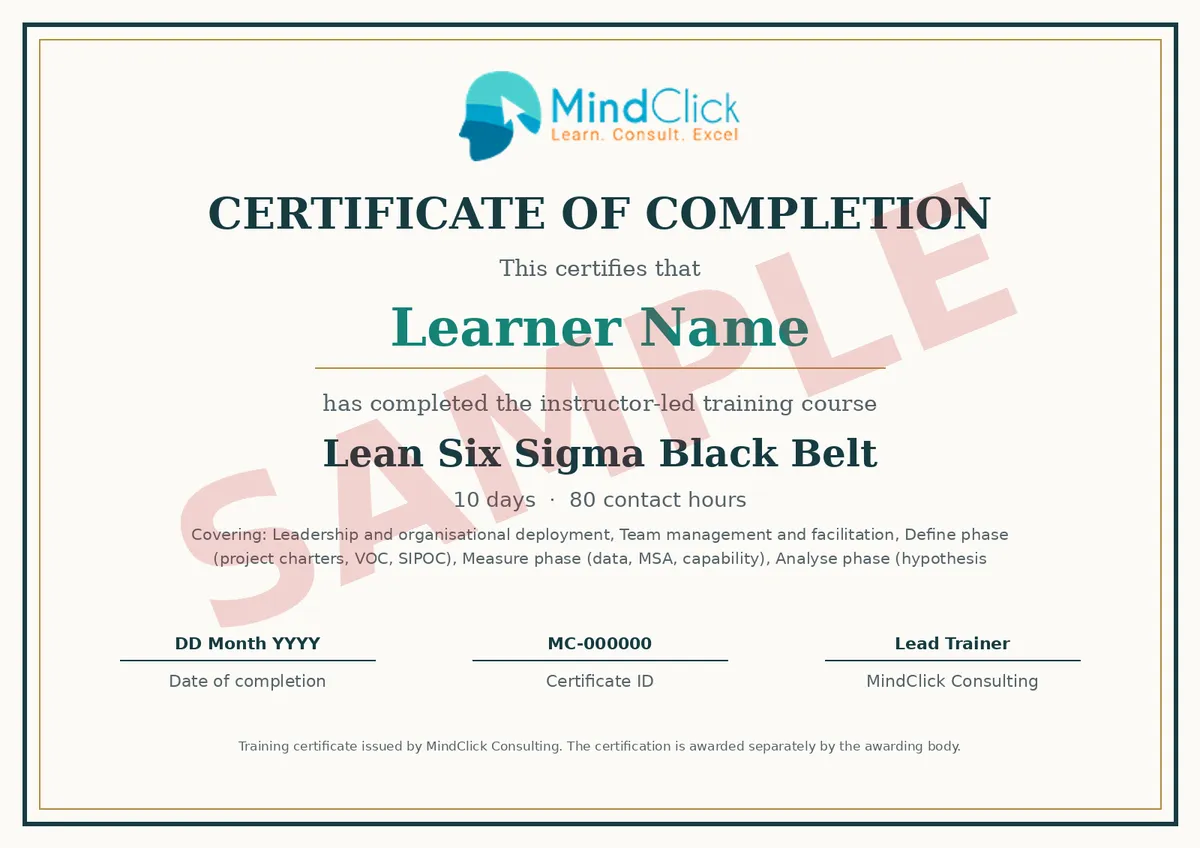
What you receive
You earn two separate credentials. The sample shows the MindClick training certificate.
- MindClick certificate of completion: 10 days, 80 contact hours, issued to every attendee who completes the course.
- Lean Six Sigma Black Belt: issued by the awarding body when you meet its requirements and pass the exam.
Before you choose your learning route
Session timings are indicative; the trainer may adjust them for the group. Exam details reflect the awarding body’s published information at the time of writing; confirm the current version when you book.
The awarding body owns this certification scheme. MindClick provides training and exam preparation and is not an accredited or authorised partner of the awarding body.
Fees
| Delivery format | Fee per learner | Exam fee |
|---|---|---|
| Live online | $2,800 USD | Included |
| Classroom | $4,500 USD | Included |
One awarding-body certification exam attempt is included in the training fee. Confirm the current fee, any applicable tax and what the fee covers in writing before you pay.
Prerequisites
- Prior Green Belt certification and experience leading improvement projects are strongly recommended; some awarding bodies may require evidence of completed projects. Bring a laptop with Microsoft Excel (and, if possible, Minitab), a scientific calculator, and data from a current or past project.
FIND YOUR START
Confirmed batch starts
Choose a published start, then review your offer in the same enrollment flow. A start date is not the full timetable or a seat reservation.
Choose your country & monthStarts
- Training location
- Manama, Bahrain
- Local timezone
- Asia/Bahrain
Venue and full session timetable to be supplied.
Starts
- Training location
- Cairo, Egypt
- Local timezone
- Africa/Cairo
Venue and full session timetable to be supplied.
Starts
- Training location
- Kuwait City, Kuwait
- Local timezone
- Asia/Kuwait
Venue and full session timetable to be supplied.
Starts
- Training location
- Muscat, Oman
- Local timezone
- Asia/Muscat
Venue and full session timetable to be supplied.
Starts
- Training location
- Doha, Qatar
- Local timezone
- Asia/Qatar
Venue and full session timetable to be supplied.
Starts
- Training location
- Riyadh, Saudi Arabia
- Local timezone
- Asia/Riyadh
Venue and full session timetable to be supplied.
Frequently asked questions
How long is the course?
10 days, 80 contact hours, normally 09:00 to 17:30 with breaks. The agenda follows the exam domains and the final day includes a mock exam.
Is the exam included?
Yes. Outside India the fee includes one certification exam attempt. Retakes are booked and paid directly with the awarding body.
Are there prerequisites?
Prior Green Belt certification and experience leading improvement projects are strongly recommended; some awarding bodies may require evidence of completed projects. Bring a laptop with Microsoft Excel (and, if possible, Minitab), a scientific calculator, and data from a current or past project.
What certificate will I receive?
Two credentials. MindClick issues a certificate of completion for 80 contact hours to every attendee. The awarding body issues the Lean Six Sigma Black Belt certification when you pass the exam and meet its requirements.
Is MindClick an accredited training partner for this certification?
MindClick provides training and exam preparation and is not an accredited/authorised partner of any Lean Six Sigma awarding body. Black Belt exams are administered directly by bodies such as ASQ, IASSC and the Council for Six Sigma Certification.
KEEP EXPLORING
More ways to move forward.
Related training from the course catalog.

Six Sigma Green Belt Certification
Five-day, 40‑hour course covering DMAIC and Lean tools for Green Belts, with practical data analysis, process mapping, and exam preparation.
Lean Management Fundamentals
2-day course on Lean principles and tools; map value streams, identify waste, apply 5S and Kaizen, and practise through realistic case work.
Lean Six Sigma Yellow Belt Preparation
Two-day Yellow Belt preparation where you map processes, analyse waste and variation, practise core tools, and finish with questions and a mock exam.
Environmental Management Systems (ISO 14001)
A 4‑day course where you map aspects, set objectives, plan controls and measure performance to build and improve an ISO 14001 EMS.